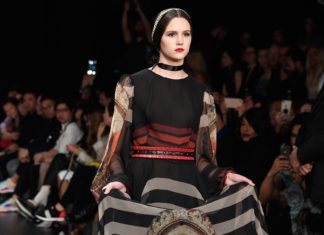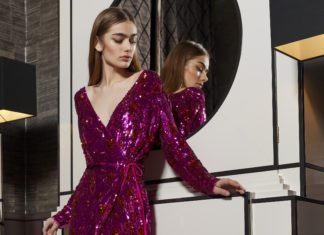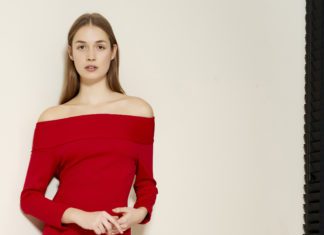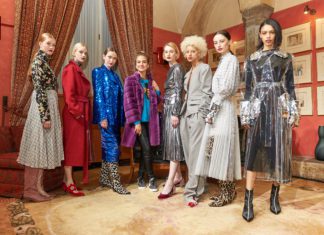

I recently had a speaking engagement at the Gregory Hotel in affiliation with Caravan Stylist Studio to discuss the trends happening on the fashion week runway, and the standout moments of NYFW FW16 (which we’re now referring to as “Spring ’16”).
The first question from the crowd was: “What designer do you feel was a standout this season?” The audience looked a bit surprised when — in lieu of the de rigueur list of mega-name, celebrity-affiliated designers (i.e., the same names that seem to fill every NYFW recap) — I unhesitatingly said, “Karigam!”
I gave everyone the correct spelling of the brand and asked the audience to look up designer Karina Gamez‘s pieces. It was clear which audience members did, because their heads started nodding in agreement.
Audience members’ heads starting nodding in agreement.
At first, the Karigam show seemed like any other at Skylight Clarkson. The runway was a square, where no onlooker had a bad angle. But as the first piece appeared on the runway, I knew that I was witnessing a special collection. It had the perfect balance of cohesion and edge: a collection for the modern woman who wants to stand out.
Gamez creates razor-sharp silhouettes with a skillful mix of fabrics — from furs and leather to cotton and everything in-between — while exploring a wide palette of colors from sharkskin grays to hard blacks, and even skillfully riffing on dark peach-colored fur.
The cuts, pairings, and layering made it clear that we can no longer think of Karina Gamez as a designer on the rise: she is here.
Karina Gamez is no longer a designer on the rise: she is here.
Maybe I have a lot in common with your average bull, but my eyes caught a lot of red at Paris Fashion Week.
A fantastic choice of color for a coat, not only for its commanding presence, but also for its longevity. I don’t know of a time where the red coat was ever “out.” While the a classic shape for the striking outerwear is an economically smart decision, should you feel the need to be extra eye-catching, this season’s take on the classic hue can inspire:
Andrew Gn
Regis Colin Berthelier / NOWFASHION
Not only is this coat the perfect pair to my earlier “running of the bulls” metaphor with its matador-esqe detail, it builds onto a classic shape. Not necessarily the most daring option out there, the detail is what distinguishes it — piping, double-breasted buttons, and the fur collar for instance — and elevates your winter wear from the thousands of other black, beige, and brown coats on the street.
Balenciaga
Guillaume Roujas / NOW FASHION
Somebody saw “Hotline Bling.” I have nothing against the classic puffy coat; in fact, I think it’s the most reasonable option, especially with biting wind and low temperatures. It doesn’t have to be a lazy piece reminiscent of eighties and nineties skiwear, as the styling here proves. Though, tossing it off of one’s shoulders requires a warm sweater, lest the whole raison d’être of such a garment be disregarded.
Saint-Laurent
Guillaume Roujas / NOWFASHION
For those who dare to make unconventional style choices, this Saint-Laurent coat is here to jumpstart your creative juices. Reminiscent of a fluffy heart, the raised shoulders and fur material are sure to keep cruel winter winds far from your vitals. That, and you’d certainly stand out in a crowd. This is the running vest for fashionistas; you can bet drivers and bikes will see you. Safety first.
Barbara Bui
Guillaume Roujas / NOWFASHION
Dogtooth is a classic pattern, especially for coats. It’s safe, almost neutral in black and white, and usually smaller than the pattern on this Bui coat. Which is precisely what makes this one so appealing; it’s a fun play on a classic with the added bonus of warmth via the woolen lining and its material. And for those who enjoy mixing patterns; its Scottish and nearly punkish vibes are prime ingredients for an interesting fusion.
Wanda Nylon
Gio Staiano / NOWFASHION
This one’s a bit of a wildcard, seeing as it’s a raincoat. Not every cold day is snowy or mere wind, but occasionally rainy. Rather than looking like a drowned rat in one’s trusty, but likely less stylish, raincoat, this option is a total win for when the sky is dumping buckets of water on you. And, if the wet-hair look remains, that’s a double win, should you forget your umbrella.
Throwing Shade: Me and Gigi Hadid Go “Matchy Matchy” … Not Really
My sunglasses always seem to come to tragic ends. My Persol 714 “Steve McQueen” series sunglasses? Unceremoniously sat on. My Dita Classe 19009d? Hung on the outside of a carry tote (dumb, I know) and left behind at In-N-Out Burger.
Making matters worse is how difficult it is for me to find sunglasses I like in the first place. Everything I wear inevitably seems to accentuate something I don’t like.
54mm-size frames look gigantic on me, making me look like Trevor Horn from The Buggles, or maybe Jeff Goldblum when he becomes The Fly. “Tiny” 47mm-size frames (like my Retrosuperfuture acetate shades) make me look like something horrible happened to John Lennon; although — at 49mm — my Saint Laurent translucent frames look pretty okay.
Long, tragic story short: I’m insanely picky, and probably just insane, when it comes to finding sunglasses I like.
Some make me look like something horrible happened to John Lennon.
I admit, since I’ve been in fashion, I’ve developed a weakness for eyewear from Japan and Italy. Although Italy still reigns supreme in the realm of handmade ready-to-wear, both Japan and Italy are renowned for artisanal eyewear, combining cutting-edge optics with painstaking craftsmanship etc.
I’ve developed a weakness for eyewear from Japan and Italy.
Mainly — after decades of being dirt poor, and going from one pair of $10 mall knockoffs to another, which tend to “spontaneously deconstruct” — my heart beats fast for anything that feels well-made. (See my entry on shoes, and prepare to shriek.)
Tangent alert: I spent the day off at Barneys yesterday, and couldn’t help but feel cheated that these Louboutin Spiked Dandelion Venetian Loafers shout “look at me! I’m fashionable!” … whereas my twice-as-expensive A1923 cordovan ankle boots go mainly unnoticed.
Which is more expensive? I’m crying as I write this.
$1,395 – Fashion forward!
$2,200 – Lives on a railroad!
My point (I guess), is how things feel is as important to me as how they look, and maybe moreso. (Although it does help if they look great, too.)
So back to my latest acquisitions, just in time for summer: Sicky CS S10 in matte black (also available in ivory), and the Sicky S1 in coffee gloss.
You may notice that my new “bff” — in terms of two completely unrelated people who now own the same brand of sunglasses, as might happen with Nelson Mandela and Kid Rock, maybe — Gigi Hadid is also a fan of the brand, wearing a number of Sicky models including the aforementioned CS S10s and the Sicky S14silver mirrored.
I’m loving my Sickys. First of all, they indeed look sick. (In the “hip” sense — you know, “dope” — not like when I drive through Burger King and get the “jalapeño chicken fries” and regret it for the rest of the day.)
The CS S10s, handmade in Japan, feature polarized lenses, which is one of my all-time favorite sunglass features when I can get them. My cellphone screen looks green; the LED clock on my car dash flickers spookily; and there isn’t a glare as far as the eye can see. Since I don’t drink or take drugs, polarized lenses are about the closest I get to feeling high. (And that’s a pretty anemic rush, I do realize.)
The S1s, handcrafted in Italy, are framed by some really thick Italian acetate, which is great to hold. I love thick acetate because it’s sort of like wearing a frame made out of non-sticky Jolly Ranchers, creating that weird urge I sometimes get to chew things that feel really great to the touch, like my Guidi-leather M.A+ origami wallet. (TMI?)
The brand is the brainchild of John Hildebrand, whose website says: “Our story continues with every individual who joins the SICKY movement, eager to see the world through a different lens. SICKY’s has become a movement lead by tastemakers in art, music and popular culture.”
As the glitterati rest up their traveled feet, and the fashion week dust settles, it’s time to regroup and what really got our hearts a-flutter this season.
The best part of the job, (besides seeing who is on the frow and who isn’t) is rounding up and cherry picking those niche-trend patterns spotted at the shows, which will eventually find their way into people’s wardrobes. Ta-da! That’s how it all works folks! In Paris, aside from the chic and minimalistic women (oh, how we want to be you) there were a number of trends that made our eyes dance.
A single chime rings out, startling me, as the first model emerges from behind the curtain at Véronique Branquinho’s Spring ’16 show. Nick Cave and the Bad Seeds’ “Red Right Hand” plays, as Cave’s sinister voice slithers through the speakers. There couldn’t have been a more fitting choice for a collection of all black ensembles, hoods, and high collars. I felt like Jane Eyre discovering Mr. Rochester’s crazed wife in the attic.
Elizabethan collars, capes, and hoods swept down the runway with the models, the floor covered in a slight dust that leapt up when disturbed. Branquinho’s aesthetic hung in the air like a misty October night. I was fairly certain that witches and the lurking madwoman in literary tradition had a say in the formation of the collection.
I felt like Jane Eyre discovering Mr. Rochester’s crazed wife in the attic.
Branquinho’s penchant for buttoned-up styles precedes her, and the reinvention of the often-ostentatious Elizabethan collar to a smaller, more chic alternative mixed with austere Puritan maxi dresses is consistent with that partiality.
Sequins — everywhere on the runway this Paris Fashion Week season — added dimension to black maxis, shape given to them as light hit the movement of the garment. A general lacing up of dresses, blouses, and even of cravats lent the collection a stuffy aura, were it not for the more radical cheetah prints and transparent gowns.
It’s as if Branquinho is seeking to enable the women history forgot, as the martyrs of an unempowered time. The Puritan-esque hoods and all black ensembles are reminiscent of Salem, the collars of the Elizabethan royal courts, as a hint of ’70s glamour trickles in with high boots, long coats, and blazers.
It’s as if Branquinho is seeking to enable the women history forgot.
She doesn’t let us languish too long in the heart-tugging tragedy of past, misunderstood characters, topping such looks with leather jackets and blazers.
Véronique Branquinho is redeeming those battered women of the past; presenting them as the fierce women they were, ending on a punctuation of looks that remind us that we’re not so different from them after all.
Branquinho is redeeming those battered women of the past.
“What becomes stylistic heritage?” asks the Louis Vuitton brand (by way of Nicolas Ghesquière) in the introduction to “Through The Roof,” the new lookbook for LV’s FW16 Collection. It’s a poignant question indeed, for a 162-year-old maison that must continue to be modern: and continue to be more than its endless line of monogrammed handbags that — like the Burberry scarf — have become so ubiquitous as to risk becoming generic.
If anyone can bring a brand up-to-date in the realm of presentation, that man must be photographer Juergen Teller. His works sit at the furthest end from the Photoshopped fantasies of the mainstream, where everyone is forever 19 years old, 90 lbs., wrinkles and eye bags don’t exist, and you should live in fear of ever being anything else.
His works sit at the furthest end from the Photoshopped fantasies of the mainstream.
(Which means, essentially, we are all doomed to live in fear.)
Although his models for LV are indeed young, the shoot — like everything Juergen does — resists modern conceptions of perfection, suggesting that — just perhaps — we are all perfect and sacred already.
everything Juergen does suggests we are all perfect and sacred already.
Enjoy the new shoot.
(Models were Sarah Dahl, Jean Campbell, Sora Choi, Shelby Hayes, Luisana Gonzalez, Natalie Westling, Alexandra Micu, and Erika Linder.)
LV FW16 Lookbook: “Through The Roof” by Juergen Teller
Paul & Joe’s spring prêt-à-porter show seemed sinister at first, red overhead lights pooling over the audience, but it proved to be just as much fun as the looks Sophie Mechaly — the founder and designer of the brand — usually sends down the runway.
The brand’s namesake being Sophie’s two sons, Paul & Joe, the new looks are just as boyish as their inspiration. Spirited suits in bold pinstripe, with deep v-cut necklines, and all in denim — a fabric obsession this season. Cravats in cat — or striped patterns with accompanying broaches — brought a certain whimsy to traditional business wear.
The new looks are just as boyish as their inspiration.
Fur accents — also incredibly popular this season — topped the collars of dresses and, of course, fur coats made an appearance as well, although in lighthearted retro stripes or a shade of slate.
Childish accents of various star and cat patterns, heart keychains hung on belts (watch out, purse poofs), and the stripes of our first-grade yesteryear seemed to be the motifs running through the collection. The decidedly schoolgirl-esque shapes made me reconsider the merit of school uniforms (almost).
One thing in the collection was clear: Mechaly is a master colorist. When Mechaly gets colorful, she gets “Matisse” colorful; it’s as though one is seeing color for the first time. And her ability to pair vivid color and playful patterns in a way that works is masterful.
When Mechaly gets colorful, she gets “Matisse” colorful.
Mechaly offers us childish sophistication, a seemingly oxymoronic concept, and ’60s inspired garments with modern idiosyncrasies. In an industry saturated with exclusivity, Mechaly reminded us that fashion doesn’t always have to be so serious, or mature … even if the real Paul and Joe are all grown up now.
Mechaly reminded us that fashion doesn’t always have to be so serious.
As the fash pack entered the Grand Palais, it was easy to mind read what everyone was thinking before they saw the interior. “What can Karl do next … ”
(Photos: Regis Colin Berthelier / NOWFASHION)
Well, it seems Karl didn’t do much more than lay down some luxurious white carpet, stack rows of gold chairs in a traditional couture-house setting, and let the clothes speak for themselves.
And did they speak! The Chanel set paid homage to the traditional collection presentation layouts of decades past. As every onlooker was in their own front row, Karl sent out a swarm of models donning boaters with singular straps, layered signature Chanel pearls, plus tweed for days.
Boasting a simplistic aesthetic for the interior, Lagerfeld took thematics “back to basics” and presented what looked like the inside of Coco Chanel’s wardrobe if she was still alive — except with some notable twists (not to mention a smattering of menswear for good measure).
Lagerfeld presented what looked like the inside of Coco Chanel’s wardrobe.
One element that brought our eyes back to the present day was the marrying of denim and tweed. Whereas one fabric is casual and has a breath of the ‘80s behind it, tweed is something the house of Chanel practically stitched out of. Today, the pairing brought a breath of fresh air, and a strong desire to wear it to the next board room meeting … because, why not!
We’re thrilled that International Women’s Day has fallen into Spring ’16’s fashion Week, especially on the day Karl Lagerfeld chose to honor the feminine form, paying tribute to the great women of the past, and the dreamers and doers of the future.
Today we have cause to celebrate two indispensable constituents of society: women and fashion.
(Photos: Guillaume Roujas / NOWFASHION)
I’m glad International Women’s Day is during fashion week because both women and fashion have been scoffed at for their frivolity, and have long endured tougher standards than their counterparts: men and other technical arts. Agnès b. held her Swan show today, fittingly, as the designer cares deeply about human rights, fair wages, and underrepresented groups. End rant.
But really, women and fashion is a swell combo.
Both women and fashion have long endured tougher standards than their counterparts.
If we’ve seen current trends made exaggerated earlier this week, Agnès b. tones them down in a softer, Gallic way. The current “Dad’s leather jacket” trend becomes instead smaller and more tailored; oversized peasant coats take on a classic shape, more like Madeline’s school coat; and while coats definitely have fur collars, it’s not too much fur collar.
The goal of this ready-to-wear collection was not to be a runway spectacle, but rather to be literally ready to wear for the modern woman.
The goal of this ready-to-wear collection was to be ready to wear.
Agnès did push limits on what the average woman might choose to wear, though, with a few looks. Notably, the designer introduces us to an extraterrestrial silver bodysuit with pedal-pushing end seams. Another original look was the twin set of an elongated white knit sleeveless shirt and pants of the same fabric, both garments with the last foot of doubly thick material. At the same time this look reminds me of post-tennis country club brunch, but it refuses that idea when paired with Converse-style shoes and a baseball cap.
Agnès b. introduces us to an extraterrestrial silver bodysuit with pedal-pushing end seams.
The last look of the show was a feminist approach to the historical custom of including a wedding gown at the end of the collection.
Instead of a gown, we have a wedding suit.
Most of her contemporaries ignore the wedding dress custom, but Agnes b. stays old school on this account. Contrast this choice with the way that Agnès b. displays a modern view on the “see now buy now” question that many of her contemporaries reject.
Agnès gives us a wedding suit.
We have to conclude that Ms. b is neither “old school” or “new school” — but just kind of cool in general.
H
aving worked under the likes of Alexander McQueen and Veronique Branquinho, Chinese designer Masha Ma is hardly a stranger to what’s edgy and new. She is what one could call “forward-thinking” — forever pushing the boundaries of the status quo.
For her FW16 prêt-à-porter collection, Masha Ma draws from “the techno underground scene” with pieces that echo Berlin’s East Side or a sleek, rave look. Certainly, the grimy-chic aura most nightlife goers embody as they slither through masses of clubbers isn’t one that normally transitions well to daylight, as most regretful partiers will attest to on a walk home in the blinding morning sun.
Masha Ma draws from “the techno underground scene” for FW16.
Masha Ma’s aim to transition nightlife vibes to daytime acceptably is a bold pursuit, one that she attains through a fusion between classic, yet notably androgynous, silhouettes and futuristic pieces. Models with purple, pink, blue, yellow, green-tinged hair and black-rimmed eyes resemble groupies … or one’s own face after a wild night.
Figuring prominently in the collection, blazers and suit pieces made their way to the runway, looking more like Friday night than Monday’s nine to five. I noticed a pair of leather pants, pleated as a nod to professional wear. An all white suit with zipper-detail at the knee and on the blouse diverged from the classic suit.
Chains and mesh from sweaty, strobing dance floors worked as sophisticated detail for monochromatic and clean ensembles in lieu of their usual commanding presence. Instead, they complimented the simplicity of the design, giving us a peek where otherwise the door would be obstinately closed.
Chains and mesh from sweaty, strobing dance floors …
As with many shows this FW16 prêt-à-porter season, high to thigh-high boots appeared on Masha Ma’s runway, almost in go-go boot spirit. And if not for the sophisticated cut of her golden accents (along with the choice of a rusty gold color), I would have said the ’60s and ’70s were back in full swing.
Besides the fluidity of nightwear and daywear in Masha Ma’s collection, the designer gives the power of her clothing to the wearer, the sleeves on some pieces able to be removed or added as one pleases. Not to mention the versatility of decidedly adaptable clothing; the jackets and blazers don’t command the wearer’s size or occasion, existing to serve varying outfits for varying styles. The designer, expressing her desire for the individual to be served above all else, presents to us a collection in the spirit of modern globalism.
Who better to represent sartorial crossover than a woman based in both Paris and Shanghai? Having studied under a Western tradition of fashion schooling and with a background in an Eastern culture, Masha Ma has insight into clothing’s ability to cross boundary lines and cultural traditions as a universal — yet personal — expression.
Masha Ma wants to redesign the way you think of Chinese creativity, but she also cedes to the desires of an individual wearer. After all, isn’t that the essence of globalism: individualism with a broadened worldview?