

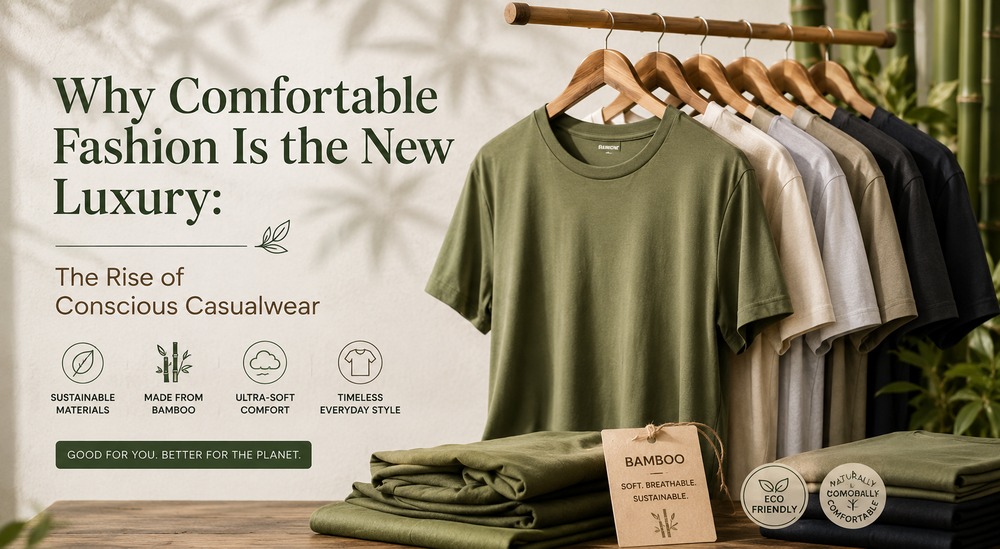
Walk through any showroom this season and you notice the same thing the buyers do.
The hands go to the fabric first. Not the cut, not the colour story, not the lookbook. People reach out and squeeze a sleeve before they even check the price. That used to be a tell of an amateur. Now it is the whole point.
Somewhere between the lockdown years and now, the thing people wanted from their clothes changed. Stiff tailoring lost its grip. The hoodie, much maligned a decade ago, turned out to have been right all along. And a category nobody used to take seriously, comfortable everyday clothing made with some thought behind it, has become one of the more interesting corners of the market. Call it conscious casualwear. The name is clumsy. The shift is real.
The Quiet Luxury Conversation Got It Half Right
For two or three years, “quiet luxury” ran the discourse. No logos, good cloth, the rich-person-on-a-yacht aesthetic. The instinct underneath it was sound: people were tired of paying for a brand’s marketing budget. They wanted the garment to be the thing, not the badge.
But the quiet luxury crowd kept the price tags. A logo-free cashmere coat at four figures is still a flex, just a subtler one. What it missed is that most people do not want a yacht uniform. They want to feel good in what they already wear every day. The genuinely radical version of “the garment is the thing” was never the silent cashmere. It was the t-shirt you reach for without thinking, the one that happens to be made well.
That is where comfort and status quietly merged. When everything is photographed and nothing is occasion-specific anymore, the flex is not looking expensive. It is looking easy. And easy, done properly, is harder than it sounds.
What “Conscious” Actually Means Now
Here is the problem with the word. “Conscious” has been used to sell everything from recycled-polyester gym shorts to a tote bag you did not need. Most of it is noise. So it is worth being specific about what the serious version looks like, because the serious version is what is actually driving the category.
It comes down to three things, and none of them are a hangtag. Material choice that holds up. Supply chains a brand will actually talk about. And construction built to survive more than a season, which is the unglamorous heart of the whole idea.
McKinsey and the Business of Fashion put sustainability back among the industry’s top three growth opportunities in their State of Fashion 2026 report, after a stretch where it had slipped down the priority list. Not because the industry suddenly found its conscience, but because value-conscious shoppers, squeezed by a few years of economic wobble, started treating durability as a feature they would pay for. A garment that lasts is cheaper per wear. People did that maths.
| Signal | Greenwashed version | The real version |
|---|---|---|
| Material | “Eco-friendly blend” | Named fibre, stated percentage |
| Transparency | A vague sustainability page | Where it is made, who makes it |
| Longevity | “Built to last” slogan | Fabric weight and construction you can check |
| Proof | A leaf logo | Wash-test behaviour, real reviews |
The brands getting traction are the ones happy to be boring about specifics. Weight in grams. Blend in percentages. Where the thing was cut and sewn. Boring is the new trustworthy.
The Fabrics Doing the Heavy Lifting
None of this works without the cloth. A comfortable garment that pills after four washes is not conscious of anything except your wallet. So the material conversation has moved past cotton-versus-polyester into more specific territory, and bamboo viscose is one of the fibres people keep landing on.
Worth understanding why, because the marketing around it is often wrong. Bamboo’s appeal is not magic. It is structural. The fibre has a round, smooth cross-section, which is part of why it feels softer against skin than cotton, whose surface is more irregular. It also carries something called bamboo kun, a bacteriostatic agent naturally present in the fibre that slows the growth of odour-causing bacteria, a property documented in research published in ACS Applied Bio Materials. That is the mechanism behind the “stays fresh longer” claim. It is in the fibre, not sprayed on.
Brands building around this fibre tend to blend rather than go pure, which is the smart move. A typical example from labels like men’s bamboo t-shirts runs around 70% bamboo viscose to 30% organic combed ring-spun cotton, near 5.3 oz/yd² (roughly 179 gsm). The cotton gives it bite and structure. The bamboo gives it the drape and the hand-feel. Neither does the job alone, which is the bit the single-fibre purists tend to miss.
The weight matters more than people expect. A tee under about 4 oz goes see-through and loses its shape by lunch. Something in the 5 to 6 oz range holds a line, drapes instead of clinging, and reads as deliberate rather than disposable. You can feel the difference in the showroom squeeze test. That is what the buyers are checking for.
Why Comfort Reads as Status in 2026
There is an economic story under the aesthetic one. The State of Fashion 2026 outlook projects only low single-digit growth for the industry this year, with shoppers spreading their budgets toward well-being and longevity instead of volume. When money is tighter, people buy fewer things and want each one to earn its place. A soft, well-made staple they will wear two hundred times wins over a trend piece worn twice.
And the cultural read followed the wallet. Looking comfortable used to suggest you had given up. Now it suggests the opposite, that you have enough taste to know the expensive-looking suit is not the flex it once was. Anyone can buy a loud jacket. Knowing fabric, caring where it came from, choosing the piece that will outlast the season, that is the quieter signal, and quiet signals have always been the status ones.
It is the same instinct quiet luxury was chasing. It just turns out the truest version of it was never in the cashmere. It was in the everyday stuff, made honestly.
Questions People Keep Asking
Is “conscious casualwear” just marketing? Plenty of it is. The test is specificity. A brand that names its fibre, states its blend percentage, and tells you where the garment is made is doing the real version. A leaf logo and the word “eco” with nothing behind it is doing the other one.
Does bamboo fabric really resist odour? It slows it. Bamboo kun, the bacteriostatic agent in the fibre, inhibits the bacteria that produce smell, which is why a bamboo-blend tee tends to stay fresher between washes than a standard cotton one. It is not a deodorant. It is a head start.
Why blend bamboo with cotton instead of going pure? Structure. Pure bamboo viscose drapes beautifully but can feel slippery and lose shape. The cotton, usually around 30% in a good blend, gives the fabric body and durability while the bamboo keeps the softness. The mix outperforms either fibre on its own.
Is comfortable clothing actually more sustainable? Not automatically. Comfort and sustainability only overlap when the garment is built to last, because the most sustainable thing about any piece of clothing is how long you keep wearing it. A soft tee that survives two hundred washes does more good than a “green” one you bin in a year.
Worth the Softness
The runways will keep doing their thing, and tailoring is not going anywhere. But the centre of gravity has shifted, and it shifted toward the clothes people actually live in. Comfort stopped being the lazy option. Made with some thought, it became the considered one. That is the whole story, really.