
From Red Carpet to Ready to Wear: Gemy Maalouf FW17
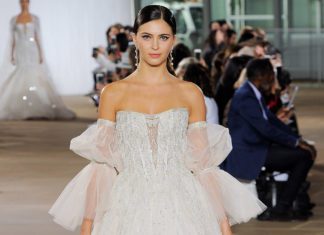
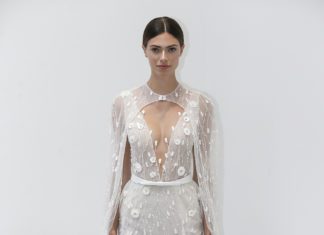
Staying true to the brand’s DNA, for FW17, Gemy Maalouf presented a collection full of fluttering gowns in ultra-feminine cuts and intricate embellishments.
The color palette was clean and neutral, giving room for the lace appliqués and beaded motifs to shine through. The intricate beading and embellishments created dazzling textures, sharply contrasted with the delicate sheer linings and silk fabrics. The light from the chandeliers in the Bowery Hotel danced off of each metallic stitch and sequin, although these details would be much more appreciated in an atelier.
Voluptuous gowns with seductive cuts were broken up by adding a few looks that were more ready to wear than in the brand’s past. Most refreshing were a brocade jacket paired with shorts, a nude two-piece look with flared bell bottom pants, and short cocktail dresses … wearable pieces for the everyday client.
Our favorite look was a black and white ethereal printed deep V-neck gown with an umbrella waistline, covered with lace appliqué and slick beading sprinkled throughout the appliqué. The few looks that incorporated this printed fabric were among the most successful.
Some numbers are sure to be seen on some of Maalouf’s celebrity following like the artists 5th Harmony and Carrie Underwood this awards season.
Italian brand Invicta was founded in 1906. Its history is long and storied, making their recent New York Fashion Week debut with FTL Moda just a little extra special. Not to mention the fact that the presentation happened completely in virtual reality. We spoke with Simone Di Stasio about the evolution of the brand.
Virtually Amazing: Invicta
Q: This is the first time Invicta has been a part of NYFW. But it isn’t your first time in New York?
Indeed, we are not new in the U.S., but our participation in NYFW brings INVICTA to the next level in this market.
Q: How do you feel about being a part of fashion week this year?
NYFW has been an emotional experience that Invicta couldn’t miss. We found there was a great interest in the brand. This means participation can really bring great results.
Q: At Pitti we already saw you embracing VR, to let customers paraglide over some pretty impressive mountains. How do you feel about seeing your collection in virtual reality?
We cannot deny that a product should be seen and touched. Today, through new technologies, it is possible to contextualize the product and make it yours in its dimension.
Today, through new technologies, it is possible to contextualize the product.
Q: Invicta celebrated its 110th birthday. What are you most proud of?
We are proud to be one of the brands with a lot of experience in the fashion outdoor world. Invicta is always contemporary, across different generations, as few other brands in the world.
Q: Can you tell us more about the origins of the brand?
The Invicta brand was born in England in 1906, and in 1921 opened its first artisan workshop in Italy. Thanks to continuous research on materials, features, and design, in the ’80s Invicta became a cult brand for an entire generation of youngsters and a real fashion and cultural social phenomenon, and we continue to work with the same enthusiasm of the founders.
in the ’80s Invicta became a cult brand for an entire generation of youngsters
Q: What’s coming next? Where is the brand heading?
The Invicta brand will continue, through its values, to bring its heritage to life: exploration, enthusiasm, emotion, thrill, color. These values will continue to be applied to everything Invicta is doing: contemporary products able to satisfy the needs of a global market.
Invicta’s famed Jolly Backpack
Q: What was the most impressive / emotional / funniest moment during the whole Invicta journey so far?
No doubt it was during the ’80s, when the Invicta Jolly Backpack became a worldwide Italian icon for traveling youngsters. More than 10 millions units were sold. We can also say that the Jolly Backpack has been the first not-virtual “social wall,” on which young people from all over the world have impressed their personal emotions.
Founded only in 2014, PH5 has already come far, thanks to the acumen of combined design / business team Wei Lin and Parsons-trained Mijia Zhang.
Their Fall Winter 2017 collection draws inspiration from artist Martin Creed, who won the Turner Prize in 2001. Emulating the softness and playfulness of balloons, the collection is embedded with PH5’s love for fun and color.
The stated aim of the collection is to “connect spectators with those feelings they have towards the colors, textures, and details of balloons. In order to accomplish this, the collection uses minimal but impactful materials and utilizes a balloon-like knitting stitch that moves freely with the body.”
We spoke with Wei Lin and Mijia Zhang for an inside look at their partnership.
Q: Are you both fans of modern art? There are clearly a lot of influences in your work, from Martin Creed (in the most recent collection) even to Mark Rothko or Paul Klee (or at least we think so).
Mijia: Yes, PH5 is heavily influenced by art. Modern art, in particular, is my design database. Each season functions like a research project on a subject I choose. I start with a piece of artwork and allow myself to be intrigued by it, which then leads me to create various elements for the collection.
Each season functions like a research project.
Q: How did you both meet, and how did you know the partnership would work? What are your creative roles?
Wei: We used to share an apartment together in FiDi New York. Mijia was completing her fashion design degree at Parsons, while I was working as a management consultant at Deloitte Consulting.
Just like many other NY stories, we didn’t meet each other with the intention of eventually working on a brand together. We were friends first, and business partners later. Each season, Mijia comes up with creative designs, and I help her execute her ideas at my parents’ knitwear factory.
Q: Knitted garments seem like quite a lot of work. Your garments especially so. What’s the process, start to finish, roughly?
Mijia: Knitwear, in general, is more complicated than wovens because the design process begins with picking the right yarns. After I come up with my inspirations, I pick the core yarns for the season by evaluating their content, size and count of the yarns, and color offering. After the yarns are selected, we test stitches in our factory development center.
After about 4-6 weeks of testing, we decide on our core stitches for the season and that’s when designing the garments finally begins. Our knit garments are fully fashioned, which means we computer-program knitting panels in the silhouette we design. Once panels are knitted and sewn together into garments, we fit and revise into the style we envision.
Q: Is fashion art? The Nobel Committee made waves recently by awarding the Nobel Prize in Literature to Bob Dylan. Do you think we should distinguish between “high” and “low” art?
Mijia: Reading art and distinguishing art is a very intimate thing. I often feel people go to an art exhibition trying to understand what it is about, but they often forget their initial feelings about the works of art.
Reading art and distinguishing art is a very intimate thing.
Art is a platform where artists can present their point of views, but the truth is, artists also expect the viewers to contribute by recognizing their own feelings. For me, the high and low should depend on the individual viewer. And we should embrace such individualism.
Q: What are your fashion influences?
Mijia: I’m hugely influenced by art. I like exploring different artists’ point of views and make my own interpretation of concepts.
Q: Who is your core customer?
Wei: The PH5 girl is a modern, working woman. She’s independent, well-traveled, open-minded, and inspired. She cares about details, comfort and functionality as much as she does fashion. She is smart and dares to be different. She likes to play with her own sense of style and is constantly looking for interesting and smart designs.
Q: What advice would you give to a designer — or design team — just starting out?
Wei: Don’t give up. Starting a fashion brand can be challenging, particularly in today’s environment. But that’s also what makes it worthwhile. Each season listen to feedback, apply it, and keep trying.
Flower appliqué, hand-embroidered birds and sheer looks dominated at the Alex Vinash Fall/Winter 2017 show.
This season it was hard to ignore subtle political messages within every collection. Vinash paid homage to the 1920s, when women were liberated from the restricting codes of fashion to discover their newfound beauty and grace through clothing.
Any correlation to the political movement resounding within most Americans right now? You can be the judge of that one. From the sheer tops and dresses to sequins and feather details, each model exuded the confidence to wear a look that demanded a certain stage presence: the very look Vinash loves to deliver. Before starting his career in fashion design, Vinash was a professional Argentinian ice skater, where his appreciation for the way every piece moves with the body was forged.
Q: Do you remember the first piece you ever made?
The first piece I made was a bodysuit that had tulle and flowers; it was so awesome! Vanity Fair actually used it for a video! It was such a memorable moment for me.
Q: What was your inspiration for this collection?
It was twofold. First, I was inspired by the Women’s Movement in the ’70s that showed the strength of a woman, highlighting the juxtaposition of her beauty and masculinity. I love the fact that their fight for equality then, resonates so strongly today.
Second, the ’20s have always been an era I’ve garnered inspiration from; I love the feathers, sparkle, and classical femininity displayed during that time period, when going on a date took an entire day just to get ready!
I was inspired by the Women’s Movement in the ’70s.
Q: Which piece in this collection do you see has the “hero piece”
My hero piece has to be the green jumpsuit with capri oxford pants! Though it looks simple, it’s a must have. You can do SO much with it!
Q: If you could dress anyone, who would you like to dress?
Well, LOTS of people — where do I begin! I absolutely love, love, love Florence (from Florence + the Machine) and Taylor Swift!
Q: What can everyone look forward to in the future of the brand?
I will continue to make a statement through my pieces, bringing my handmade work to life. I believe in making beautiful clothes that make people feel even more beautiful.
(By Irene Cacciarini; art directed by Pablo Patanè)
The Shows
Virtual reality may still be in its infancy, but FTL Moda was quick to make history with NYFW’s first-ever all-virtual show, in conjunction with FWO and Samsung.
After a successful series of shows during New York Fashion Week in September 2016, Samsung continued their collaboration with Fashion Week Online, RNWY, and multipurpose platform FTL Moda, founded by Ilaria Niccolini.
On February 14th, the 6th day of Fashion Week — and the official day of love — New York’s fashion elite gathered at Samsung’s Space 837 in Chelsea to present the Future of Fashion: fashion shows in pure virtual reality.
New York’s fashion elite gathered at Samsung’s Space 837.
The VR experiences were produced in Milan by the FTL Moda team, creating five stunning shows featuring international designers Limor Ben Yosef, Premal Badiani, Fllumaé, Sonja Tafelmeier, and Invicta, one of FTL Moda’s showroom brands.
The VR experiences were produced in Milan by the FTL Moda team.
At noon, Space 837 opened their doors to fashionistas, trend watchers, and celebrities. It was divided into a showcase, a museum, red carpet, and a VIP room.
Huge Samsung displays and virtual reality glasses brought FTL Moda’s vision to life, and left some guests almost speechless.
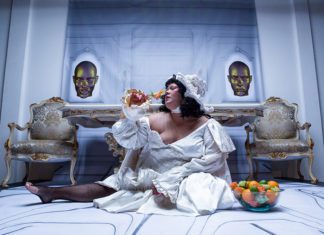
A huge video installation (page top) created by Irene Cacciarini and directed by Pablo Patanè was created for the makeup room, featuring Make Up Pro. According to Ilaria:
“We created a makeup room experience with a long conference table and an extra long white canvas, and we included 100 lipsticks to be used to leave all sort of messages. The backdrop utilized three huge LED screens by Samsung, in a video made up of interchangeable faces. The faces were generated by combining different identities: we like to think of our platform’s vision as an ‘inclusive’ one, that gives voice, stage, and opportunity to all identities that share the common good.”
You can see some of the virtual reality presentations from the event here. Meanwhile, enjoy some of the 2D shows and pictures of the event and featured designers below.
Not surprisingly, Next Model Management makes use of some of the best MUAs and stylists in the business. The Lounge celebrates these artists, as well as highlighting some of the projects of the very-entrepreneurial Next Models roster (including Clara McSweeney, who appears on the cover.)
You’ll learn about superstar MUA Renee Garnes‘ “five favorite products,” model and entrepreneur Xiao Wang‘s jewelry business, the new swimwear line August from Gabriela Rabelo, and enjoy an interview with TV personality Nigel Barker. Plus a whole lot more.
Want an inside look at the industry? Flip through the pages below and enjoy!
The Lounge, Issue 6
Credits
The team for this season’s The Lounge cover shoot included:
NEXT Model / Clara McSweeney
NEXT Photographer / Brad Trifitt
NEXT Hair / David Lopez (celebrity hairstylist for Chrissy Teigen and Hailey Baldwin)
NEXT Makeup / Sheri Terry (celebrity makeup artist and groomer for Rob Lowe, Liam Neeson, Lucky Blue Smith, Vince Vaughn, and Adrian Brody)
NEXT Creative Director / Gina Duckworth
Location: Sandbox Studio in Brooklyn
Beauty credits for the cover shoot:
David Lopez using T3 tools and Kenra Platinum Hi-Def Hair Spray
Sheri Terry using TEMPTU Perfect Canvas Foundation #5.5 and highlight and pink champagne shimmer, Make Up For Ever glitter in gold, pink and prism, NARS Bavaria shimmer eyeshadow, NARS China Seas Eyeshadow Duo, Armani Eyes to Kill mascara in black, and Urban Decay eyeliner in poppy
Cue Prince’s “Raspberry Beret” and George Michael’s “Faith.”
The ’80s were calling from the New York Fashion Week runway, particularly from the Son Jung Wan Fall/Winter 2017 collection. Think freedom, change, and affluence, as far as the eye can see. As one of the most experimental decades in history, it was an age of rebellion and taking risks.
The dramatic collection for both men and women emphasized the iconic exaggerated silhouettes of the ’80s with various layered materials and textures from bold, handcrafted knits, and glamorous embroidery to velvet in the most sumptuous shades.
“I used a funky color palette of turquoise blue-green, ivory, lipstick red, and wine,” said Son Jung Wan. That she did. Models strutted down the runway adorned in rich hues that felt seasonably appropriate, bold, and luxe.
I used a funky color palette of turquoise blue-green, ivory, lipstick red, and wine.
The designer mixed and matched different checked patterns, and dove deeper into the era with off-the-shoulder fur stoles, oversized collars, and metallic embroidery. With unapologetically bold fur accents and luxurious patterns, Son Jung Wan’s collection gave a serious nod to the confidence of the decade while exuding a sense of contemporary sophistication.
The designer explored the extravagance of the ’80s.
When asked about how this collection had changed her as a designer, Son Jung Wan said, “It excites me. It makes me feel more glamorous and energetic.”
Hailing from China, Chi Zhang had his premiere show at the Space Shuttle Pavilion last week and took NYFW by storm.
Although he has been awarded consecutively for the last 7 years as a designer in China, this was his first collection showing at NYFW. Zhang is deeply rooted in a change for the environment, especially in China, where masks are often worn due to the air pollution. In his collection, the use of gas masks is a symbol for just that. I was able to snag an interview with the designer right before his collection entered the runway.
Zhang is deeply rooted in a change for the environment.
Q: Describe in one word exactly what it feels like to be showing at New York Fashion Week?
EXCITING! Yea, exciting.
Emily Burnette interviews Chi Zhang backstage
Q: How did the concept of the use of dancers as models come into play?
I’ve done dancing many seasons now, back home. But it’s very lucky for me here because you know all the dancers here are much better than back home. I casted so many New York freelance dancers here, it’s very good; you’ll see it later.
Q: How did you become so involved and interested in the environment and pollution?
I am against air pollution and back home it is so bad, so we have to protect ourselves. So back home when we sell one piece, we buy a tree seed to plant a tree.
When we sell one piece, we plant a tree.
Q: What do you hope your audience takes with them tonight after seeing your collection?
They’re happy. More energy, more life, more enjoyable. Like me, I enjoy my life every day, I want them to feel my energy. I’m happy everyday.
We’ve been entertaining a (possibly) strange idea for some time.
It’s the notion that “cultural appropriation” is ultimately impossible. Not because people shouldn’t respect others’ cultures — but for a rather diametrically opposed reason — because of an idea that hasn’t quite come to full fruition yet: that we are one race and culture, with lots of little parts, rather than multiple races or “types” of people. The idea that we are truly one family on this planet is still a bit underdeveloped.
The idea that we are one human family is still a bit underdeveloped.
“We” humans invented jazz, built the pyramids, created sushi, built and lost Rome … and did a lot of really bad stuff to each other, too. We are one people here.
So it’s with great joy that — in spite of the current political climate — we noted (with a little help from The Riviera Agency) that New York Fashion Week seemed to remain a melting pot of international designers and influences.
Anniesa Hasibuan is an Indonesian designer, known for her all hijabi models, Anniesa brought hijabs and modest fashion to the runway in a fab way. This season many of the models were immigrants, green card holders, and 1st/2nd Generation Americans. To not only make a fashion statement, but a political statement as well.
Hakan Akkaya broke gender norms and muslim conformity by bring a New Age burka to the runway one on a male model, and the other on a female. Both athleisure burkas were designed with a fitted hat and patten leather cuffs.
Chinese-Japanese designer Dan Liu brought some of his Asian influence into his runway show — along with a good bit of French — with red geisha-inspired makeup and pops of anime emojis.
The “Dressed To Kilt Multi-Line Charity Runway Show” brought us hot guys and celebrities in traditional (and New Age) kilts and highland attire straight from Scotland.
We’ve been saying for some time that there’s no better time to be in fashion. And this season couldn’t have made us feel any better — prouder — to be a part of a world where everyone is welcome, and the only thing that matters is the state of your heart.
Perfection is, as they say, more of a journey than a destination. RtA (or Road to Awe) is just such a journey, summoned wholly by intention: an undertaking by three friends, Eli Azran, David Rimokh, and Evelyn Ungari, committed to a process of constant improvement.
The collection itself has an almost ikebana-like philosophy. It’s not so much one single “thing they do,” but a desire to achieve an overall effect.
In this case, the desired outcome is a woman who feels comfortable in her own skin. And more than comfortable: sexy, confident, and perhaps just a little dangerous.
Show credits: Hair provided by Linh Nguyen for Cutler, makeup provided by Marc Reagan for Bobbi Brown, and nails provided by Momo Quinn.
Interview by Kyleigh McCollam
The palette for this season’s RtA was made up of “liquid black, used blue, chalk, and wine, accented with chain mail, skins, fox, raccoon, and lamb that sit alongside oversized jean jackets and sweatshirts.”
Kyleigh caught up with Eli Azran and David Rimokh at the show to find out more about the new collection, and what makes the partnership tick.
Q: What’s the inspiration behind this collection, and where do you go to get inspired?
Eli: We’re fortunate to live in LA, the birthplace of jeans, leather jackets, and t-shirts. You don’t have to go very far for that. So as far as inspiration is concerned, I would say it’s a daily thing. We’re lucky enough to live in the capital of that look.
David: The brand is all about effortless chic. Items in a girl’s everyday wardrobe. T-shirt, jeans, denim. Biker jackets, cashmere.
The brand is all about effortless chic.
Eli: Everyone kind of aspires for the “off-duty model” look, but how do you translate that to normal people?
Q: How do you do it?
Eli: It’s art. It’s a lot of work.
David: There’s a whole magic to it. Yes, it’s a lot work. It’s making sure we get things right.
Eli: Usually the simplest things in life are the most challenging to get good at.
Q: Like in, say, cooking. Sometimes it’s the balance …
David: Yes. It’s like making a cake. Any wrong ingredient can mess it all up.
Eli: One of the things we say in the office is that it’s like a race car. You can have the best race car in the world, and like 99.9% of it is perfect. And there’s one screw that’s loose, and it explodes. So we always have to work together and be very on point.
That’s what RtA (Road to Awe) stands for. A constant journey to better yourself. So every season we’re getting better, improving ourselves, and we’re adding more.
David: Sometimes common sense isn’t so common.
Q: What are some of your favorite silhouettes you incorporate into each collection?
Eli: We always have a lot of higher wasted stuff, a little slouchy. There’s not a specific thing that we do. It’s more of an understanding and an idea of like look, “Your girl needs to feel this way. And feeling cool is better than looking pretty. Because a cool girl will always have that aura about her that you can’t describe.”
David: Nine times out of 10, if a girl feels cool, she is cool.
If a girl feels cool, she is cool.
Eli: Evelyn, who you met, is our “cool girl” test. We’ll say, “What do you think, Evelyn?” And if she says yes, we’re good to go. Or, “No, I hate it.”
Evelyn is our “cool girl” test.
David: She’s our muse.
Q: So it’s pretty much how you feel inside versus what you look like?
David: It’s that confidence.
Q: How do you feel your brand has evolved since you first began?
Eli: It’s a crazy thing, because when we first started the brand we used a lot of denim and a lot of leather, because those two mediums are kind of endless. You can do anything with jeans, and you can do anything with leather. So the evolution has been opening up categories, taking the jeans and adding things that complement the look.
That fur jacket that you’re going to wear with that cashmere sweater, those leather pants. Those are key magic words for girls. We have a men’s line as well, that we just launched at Barneys, and it’s really so different.
Everyone’s always asking me, what’s the difference between men and women’s, and for me, men’s is reality, women’s is fantasy. With women’s there are no boundaries.
Men’s is reality, women’s is fantasy.
Q: What is the best part of being a fashion designer? What do you enjoy most about it?
Eli: The best part about being in RtA is that we get to hang out with our best friends in the world. And we get to work together, and build something that’ll be here for a long time, and a lot of people will benefit from.
David: We work with no restraints. We’re all best friends, we’re all family. There’s nothing really holding us down. If we want to do something it’s up for negotiation.
We’re all best friends, we’re all family.
Designers Eli Azran, Evelyn Ungari and David Rimokh during their RtA Fall/Winter 2017 Presentation held at Industria in New York, NY on Febuary 10, 2017. Photo By Craig Barritt/WME IMG
Eli: Also, we look at the opportunity we’ve had to be in this kind of environment with the brand and the timing and this and that, we are so careful not to f*ck it up — sorry — because basically we are blessed. We spend more time at work than anywhere else.
Q: It definitely didn’t fall from the sky, a lot of hard work.
Eli: Well, maybe there’s a little sprinkling of fairy dust on top, but we definitely put in the hours, because we know what we have to lose. It’s not just about being unsuccessful. It’s losing the opportunity to work with your family.
David: These days anyone can become relevant really fast. But it’s how you stay, and continue making making magic. That’s what we try to do.
These days anyone can become relevant really fast. It’s how you stay.
Learn More
RtA (Road to Awe)
RtA launched in the spring of 2014 by Eli Azran and David Rimokh. The brand is based in Los Angeles. RtA is sold at top retailers including Barney’s, Bergdorf Goodman, Elyse Walker, Hirshleifers, Intermix, Maxfield and Patron of the New, in the US, as well as numerous doors in Europe and Asia (Selfridges, Montaigne Market, Antonia, Restir, Club Designer). RtA’s Flagship store opened in January 2017 on Melrose Ave in Los Angeles, with Miami and New York opening later this year. The brand has gained a strong influencer following – Kendall Jenner, Gigi Hadid, Heidi Klum, Alessandra Ambrosio and Olivia Wilde are all fans.