

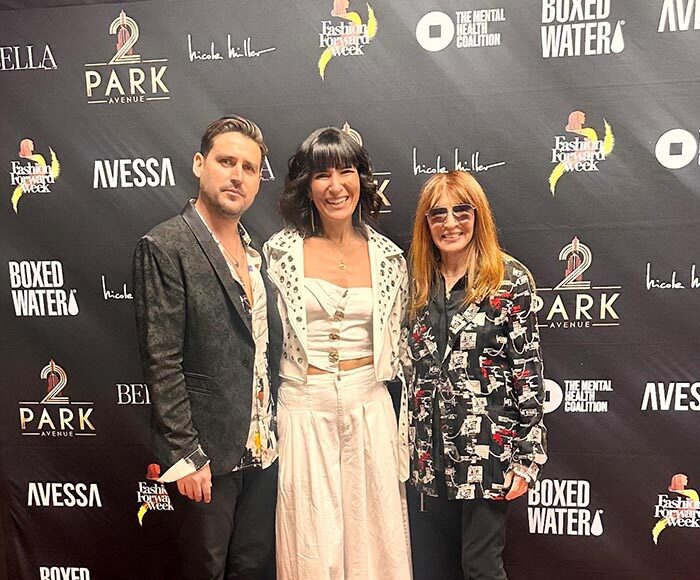
In an era where the industry races toward the future, Fashion Forward, the platform led by Jordana Guimarães and Christopher Hunt, is making a compelling case for looking back.
Their model, built on archives, deadstock, and creative collaboration, reframes sustainability not as a trend, but as a return to fashion’s origins.
The concept emerged organically, shaped by a series of defining moments. When Nicole Miller joined their most recent Fashion Forward Week in New York, Hunt immediately recognized the power of her legacy. “Nicole has such an amazing history. Why don’t we showcase it with a presentation?” he recalls.
That instinct, paired with insights from industry colleague Charlie Ross, sparked a new direction: archive-driven storytelling, upcycling, and education. For Guimarães, the shift felt inevitable. “For the last 10+ years, I have been pushing sustainability… it has always been in my DNA,” she says.
Reinterpreting the past through the eyes of the next generation
Fashion Forward’s process is intentionally simple and radically effective.
“It’s the interpretation of the storytelling of the brand from the eyes of the next generation,” Guimarães explains.
By partnering with universities, the platform places archival materials and deadstock directly into the hands of students, who transform them into contemporary, market-ready collections. The result is a fusion of heritage and innovation that resonates with today’s consumers.
Photos: Jordana Guimarães and Christopher Hunt.
Who belongs to this ecosystem?
The platform is designed for brands with 15+ years of history, those ready to embrace sustainability or reconnect with younger audiences. What matters most is authenticity and a willingness to engage with narrative. Hunt puts it succinctly:
“Everyone wants an original story… it makes everything more personal, and it humanizes fashion,” a sentiment that captures the emotional core of their platform.
What the Archives Reveal
Exploring archives has reshaped their understanding of fashion’s cyclical nature.
Guimarães reflects: “Fashion is always recycling… it educates consumers on the artistic integrity of the past.”
Hunt, drawing from his background as a musician, adds:
“I like to go back when performing to the history behind the music I am singing it holds true to fashion in the same way.”
Spotlighting emerging talent
When selecting designers to reinterpret archival pieces, the founders look for one quality above all: passion. “Someone who isn’t afraid to think out of the box while still holding respect for the brand’s story and aesthetics,” they emphasize.
They highlight creators who embody this ethos, including Boho Basement by Mia, whose transformations of archival garments “blew us away,” and La Roja by Misha, a South American upcycling brand they describe as “incredible.” They also admire the work of Stuart Trevor, founder of AllSaints, whose luxury upcycled line aligns with their mission.
A global vision for circularity
Fashion Forward is not confined to the U.S. “Definitely global,” they affirm. “When we think of sustainability… we think of an emergence of cultures.”
For them, cultural exchange is not an accessory to sustainability; it defines it.

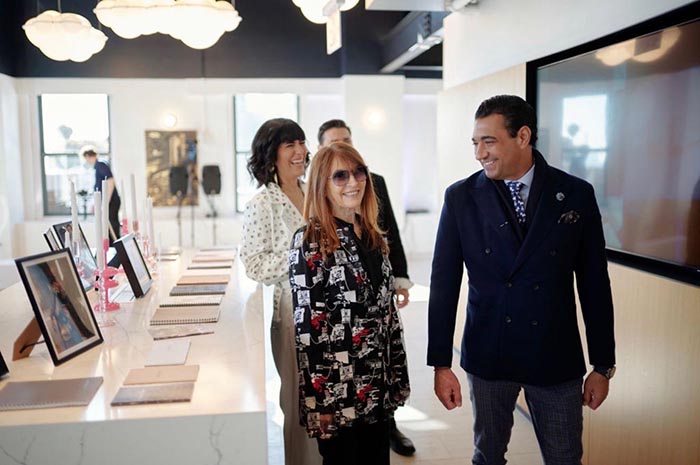
Photos: Jordana Guimarães and Christopher Hunt.
Removing barriers to circular models
One of the biggest obstacles for brands is finding the right partners. Fashion Forward solves this by curating the ecosystem for them.
“We are making the process simple… by bringing in the right players,” they explain.
Their closing message reframes the future of fashion with clarity and conviction:
“Fashion is no longer about what’s next but looking at the origin (the past)… reconnecting to the consumers rather than relying on more technology.”
Fashion Forward is more than a platform; it’s a cultural shift. A reminder that the past is not something to achieve, but something to activate. And in the hands of the next generation, it becomes a blueprint for a more meaningful, sustainable industry.