

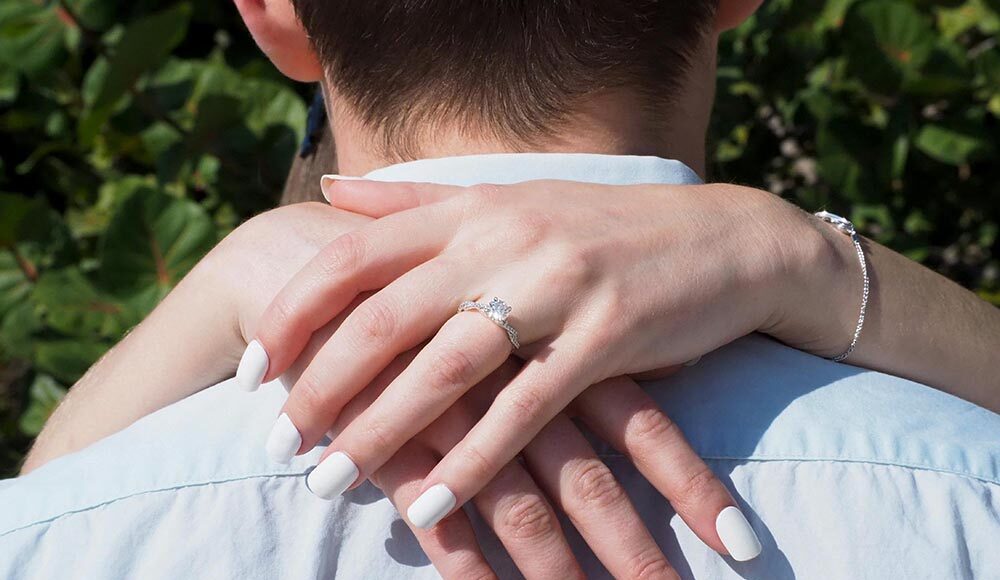
The way we think about jewellery has undergone a quiet but significant revolution over the last few years. Not long ago, an engagement ring was treated like a solo performer.
It was the star of the show, sitting on its own finger, usually expected to carry all the symbolic weight without any help from other pieces. It had its place, its purpose, and it stayed strictly in its lane.
Fast forward to today, and the landscape looks completely different. We’ve moved away from the idea that jewellery has to be formal or “finished.” Instead, we’ve embraced a more fluid, creative approach where the pieces we wear every day are part of a larger, evolving story. Engagement rings aren’t isolated anymore; they are part of a wider composition, styled with a sense of intention that feels deeply personal.
The Shift Toward Everyday Styling
The modern approach to jewellery is less about “matching” and much more about “curating.” We no longer save our best pieces for a special occasion that might happen twice a year. We wear them to the office, to the supermarket, and out for coffee. Because of this, the design of these pieces has had to adapt. If you spend a little time looking at different styles of engagement rings, you quickly notice that designers are thinking about the “afterlife” of the ring. They are considering how a diamond or a gemstone will sit alongside a gold band, a textured ring, or even a piece of costume jewellery.
The significance of the ring hasn’t faded at all. If anything, it’s actually become more meaningful because it’s more integrated into our lives. It’s no longer a fragile object kept on a pedestal but something lived with, bumped around, and woven into our daily identity. It’s a constant anchor in a look that might change every single morning.
The Art of the Stack
Stacking is perhaps the most visible part of this trend. It probably started with the traditional wedding set, but it has grown into something much more experimental. We’ve moved past the “rule” that you only wear one or two rings on that specific finger. Now, it’s about building layers.
You might see a slim, minimalist gold band paired with a ring that has a heavily textured, hammered finish. You might see a vintage-style engagement ring sitting between two modern, geometric bands. The beauty of stacking is that it’s never finished. You can add a new ring to the pile to mark an anniversary, a promotion, or just because you found a piece you love. There is no longer a single “correct” way to do it, which takes a lot of the pressure off. It’s about what looks good to you when you look down at your hands.
Mixing Metals and Breaking Rules
For a long time, the fashion world was governed by a fear of mixing metals. If you wore silver, you wore silver. If you wore gold, you stayed with gold. Mixing them was seen as a bit of a mistake, a sign that you hadn’t quite pulled your look together.
Today, that rule feels incredibly dated. In fact, deliberate contrast is one of the hallmarks of modern styling. A cool, platinum-set stone looks brilliant when nested against a warm yellow gold band. It creates a visual depth that a monochromatic set just can’t match. By mixing tones and textures, like a high-polish finish next to something matte, you create a look that feels “undone” in the best possible way. It looks like you’ve collected these pieces over time rather than buying a pre-packaged set from a shop window.
Jewellery as Movement
Another thing that’s changed is how we perceive jewellery in motion. We used to look at rings in still boxes, but now we see them through the lens of street style and social media, where hands are always moving. They’re holding coffee cups, typing on laptops, or gesturing during a conversation.
Jewellery has become part of a broader visual narrative that includes our sleeves, our nail art, and even our watches. The engagement ring often acts as the steady heartbeat of this look. While the smaller “trend” rings might come and go depending on the season, the engagement ring remains the focal point. It provides a sense of continuity even as the rest of your style evolves.
Why Asymmetry Works
We also see a lot more appreciation for asymmetry now. The old-school approach was to keep things balanced and identical on both hands. Now, it’s much more common to see one hand heavily “stacked” with four or five rings while the other hand has just one or two delicate pieces.
This imbalance feels more natural and human. It’s less about achieving a perfect, symmetrical “look” and more about wearing what feels comfortable. If you’re right-handed, maybe you want fewer rings on that hand so they don’t get in the way. Modern jewellery styling respects that practicality. It acknowledges that we are active people and our jewellery needs to work for us, not the other way around.
Choosing the Long Haul
Because of these trends, the way people choose rings is changing, too. There is more thought given to “stackability.” People are looking for settings that allow a band to sit flush against the engagement ring, or “low-profile” designs that don’t snag on knitwear or feel too top-heavy when paired with other pieces.
But this doesn’t mean you have to choose a boring or safe design. It just means finding a balance. A very bold, sculptural ring can be the centrepiece of your collection, but you might choose to surround it with very simple, understated bands so it has room to breathe. It’s all about the conversation between the different pieces.
A Focus on Authenticity
Ultimately, this shift mirrors a bigger change in the world of fashion and self-expression. We are moving away from the idea of “perfection.” We don’t want to look like we’ve stepped out of a catalogue; we want to look like ourselves.
Jewellery is a way to tell a story that is uniquely yours. An engagement ring might be the starting point of that story, but it doesn’t define the whole thing. It can sit alongside a ring you bought on holiday, a family heirloom, or a piece you treated yourself to just because.
This relaxed, intentional approach makes jewellery much more accessible. It’s about responding to what feels right in the moment. Your “stack” might look different on a Tuesday than it does on a Saturday night, and that’s perfectly fine. By embracing this flexibility, we’ve turned jewellery into something that isn’t just a symbol of the past, but a living part of our present. It’s a quiet reworking of tradition that feels much more in tune with how we actually live today.