

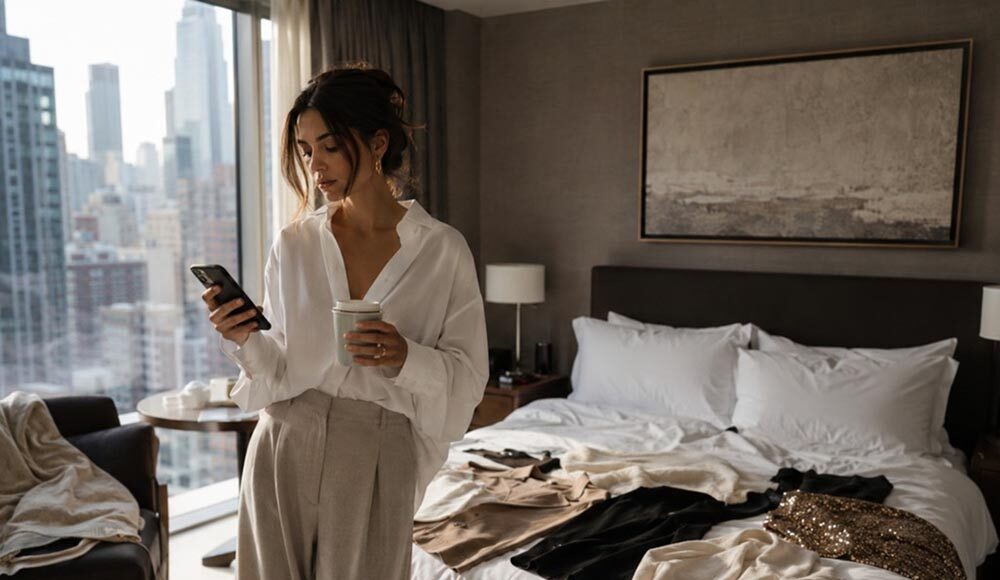
The hardest part of fashion week was never choosing the outfit. It was everything else.
Look familiar with this scenario? It’s 7:45 AM, in a hotel room in Manhattan and the day has not even begun, but the maths are starting to go out of window.
It also has a 10am event at Chelsea, a showroom appointment at noon at SOHO, a street style window somewhere in between, a 7pm dinner in the West Village and the after party in Brooklyn will begin at 10pm.
The weather says 58 degrees and rain by 3 PM, which eliminates two of the three outfit options laid out on the bed. The third option works, maybe, but only with a jacket that is still packed at the bottom of a suitcase. And somewhere in the group chat, plans for lunch just changed.
This is the reality of fashion week that the coverage rarely shows. It is not a glamorous parade. It is a logistics puzzle wrapped in a style challenge, repeated for four to seven days straight.
The Real Luxury Is Having Your Logistics Handled
There is a reason that the most polished people at fashion week almost always have a team. A stylist pulling looks. An assistant managing the calendar. Someone who checked the weather, mapped the route between venues, and built in a thirty-minute buffer for the crosstown cab that never comes.
For the growing number of attendees who do not have that team — independent stylists, emerging designers showing for the first time, content creators covering fashion week on their own budget, fashion students with one invitation and a dream — the preparation falls entirely on them. And it is a lot.
This is where personal AI has begun to appear. Not as a fad, but as a solution to a actual challenge: What occurs in a week that alter 12 times a day, whilst while you’re responsible for selecting your garments?
AI Moved Into the Closet Before It Reached the Runway
The fashion industry has been talking about artificial intelligence for years, mostly in the context of supply chains, trend forecasting, and generative design. Those conversations happen in boardrooms. The more interesting shift is happening in hotel rooms and studio apartments — where individuals are starting to use AI for their own preparation.
The personal AI agent operates not as a fashion app, but as a personal assistant that helps get fragmentated tasks relating to clothes, schedules, reminders, notes, etc., into mini-tools that follow its unique way of cooking.
For example, Macaron handles shoelaces better than it handles taxi service, or, for an assistant, it’s better at organizing meals than coordinating your socks. It keeps track of preferences, evolves over time and suggests more concrete ideas that don’t fall into a ‘pragmatic answer’ category reserved for human beings.
In the specific context of fashion week, this may sound like creating outfit archives by event and weather prediction, or sending reminder emails a couple hours too early for the date of tomorrow’s gallery opening back in Tribeca—the distance traveled between the Javits center and Tribeca takes longer than GoogleMaps would think.
Seeing the Look Before the Sidewalk Sees You
Street style photographers tend to stop people who look intentional. That word comes up constantly in the fashion week conversation — not overdressed, not underdressed, but considered. The difference between a look that photographs well and one that does not is rarely about the price of the clothes. It is about whether the person made the decision or the decision made itself at 8 AM under pressure.
This is where virtual try-on tools have become genuinely useful. A virtual fashion try-on lets someone upload a full-body photo and preview an outfit on their own figure before committing. Swap the jacket, test a different shoe, see whether the proportions actually hold together — all before leaving the room.
It may sound diminutive, but it’s a big problem at fashion week. Anybody who has ever had to pack five outfits for a three show day will know what you meant when you said you’d had all the clothes in the closet and didn’t know what to pack until you started coming late. There are no digital-like down home style cuts. It provides the concreate to which taste reacts.
The Schedule Is the Silent Killer
Ask anyone who has survived a full fashion week what the hardest part was, and most of them will not say the outfits. They will say the schedule.
Shows run late. Invitations arrive the morning of. A showroom appointment that was supposed to take thirty minutes turns into an hour. And once one thing slips, the rest of the day starts to compress — which is how someone ends up sprinting down West 36th Street in heels, texting an apology to a PR contact, and missing the one show they actually cared about.
A daily planning assistant that reorganizes the day each morning by priority, builds in lead time, and flags conflicts before they become problems can be the difference between a week that flows and a week that falls apart by Wednesday. This is especially true for anyone managing their own calendar without an assistant — which, at this point, is most people who attend fashion week outside of the front-row circuit.
The instinct is to treat scheduling as a separate problem from style. But during fashion week, they are the same problem. A missed show is a missed outfit opportunity. A late arrival is a lost street style moment. The logistics and the fashion are more connected than most people admit.
The Point Is Not Optimization. The Point Is Presence.
There is a version of this story where AI turns fashion week into a perfectly scheduled, algorithmically curated, maximum-efficiency experience. That version sounds terrible.
The reason people go to fashion week — really go, beyond the professional obligations — is because it is one of the few weeks a year where personal expression, social energy, and creative intensity all peak at the same time. The goal should never be to optimize that. It should be to arrive prepared enough to actually enjoy it.
What personal AI does well is absorb the low-value cognitive load: the reminders, the weather checks, the scheduling Tetris, the outfit previews. That leaves more room for the high-value parts — the unexpected conversations, the show that changes the way someone sees a silhouette, the street style moment that happens because someone felt confident rather than rushed.
The technology is a means, not a destination. The destination is still fashion week — loud, chaotic, inspiring, and deeply personal.
Preparation Is Part of the Performance
There is a wonderful thing about fashion week that all discussions tend to fall into a couple of pigeon-holed categories: what’s going on at the shows and what people are wearing between shows. There’s also the third category which seldom gets discussed, how they get ready.
Preparation has always been part of the performance. The look that seems effortless on the sidewalk outside Spring Studios was planned the night before, adjusted for weather at 7 AM, and stress-tested against a packed schedule. The attendee who floats calmly from a morning presentation to a lunch meeting to an afternoon show is not relaxed by nature — they are prepared.
What is changing is the toolkit. A generation ago, preparation meant a printed schedule and good instincts. Today, it increasingly means personal AI that can preview an outfit, reorganize a day, and catch the logistical details that would otherwise surface as problems at the worst possible moment.
The next time you are packing for fashion week — pulling reference photos, checking show times, figuring out how to fit four outfit changes and six venues into a single day — the prep might start with a conversation, not a spreadsheet. And the best part of having your logistics handled is not efficiency. It is the freedom to actually be there.