

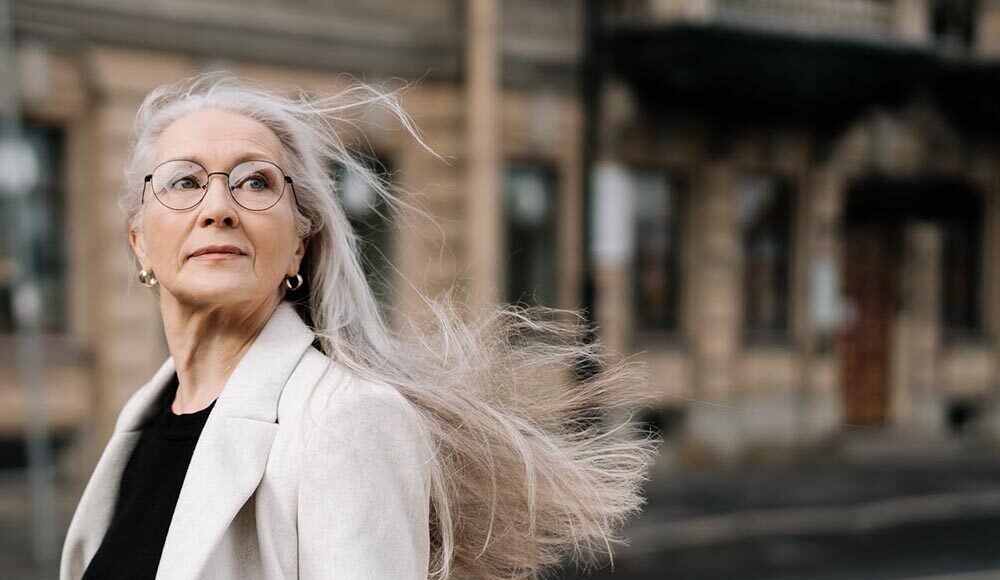
Style knows no years. It knows self-expression, experimentation, and confidence, and those things don’t diminish with age; if anything, they become stronger.
Yes, the industry still floods feeds with youth. But that doesn’t mean older style leaders don’t exist. They do. You just need to look past the algorithm’s defaults.
Why Style After 50 Still Matters (and Pays Off)
Fashion has always rewarded visibility. What’s changing is who gets to claim it. And women over 50 control a significant share of global spending power. Makes sense: in your twenties, you can’t invest in true statement pieces; not nearly as much as you can over the age of 40 and beyond.
Yet representation lags behind reality.
There are significantly more 20-something and 30-something fashion influencers and style icons, although that’s been slowly changing, thankfully. Still, the gap is evident. While unfair (and frankly uncomfortable at times), that gap also creates opportunity. When you invest in personal style now, you, unlike many youngins, are not chasing trends. You’re refining signals: competence, confidence, discernment. And those signals carry weight in professional settings, cultural spaces, and social life alike. And unlike trend-hopping, refinement compounds.
So no, style after 50 isn’t about “looking younger.” It’s about looking fabulous exactly as you are.
From Outliers to Leaders: The Rise of 50+ Fashion Power
For years, older women in fashion were framed as charming exceptions. That framing is eroding.
Take Michelle Yeoh. After decades of work, her recent red carpet presence doesn’t lean on spectacle. It leans on precision: clean lines, intentional volume, minimal but decisive jewelry. The effect feels modern because it refuses gimmicks.
Or consider Phoebe Philo’s continued influence. Even outside the traditional fashion cycle, her design language—restraint, proportion, intelligence—shapes how women with experience want to dress now. Not louder. Sharper.
And then there was Iris Apfel, whose passing in 2024 closed a chapter but not an argument. Her legacy still proves that age never diluted authority when taste stayed curious and self-directed.
These women aren’t “aging well.” They’re leading.
Modern Style Prioritizes Attitude Over Age
The current shift in fashion isn’t subtle. Age matters less than posture—literal and figurative.
Refined tailoring sits at the center of this change. Strong shoulders, trousers that hold their line, coats that structure the body instead of clinging to it. Tailoring signals intent. It says you chose this silhouette, not that you settled for it.
Accessories do heavier lifting, too. Bold eyewear, sculptural earrings, decisive footwear. Not excess. Emphasis. A single strong element often does more than a full ensemble trying too hard.
And silver hair? It no longer needs translating. Designers now style gray and white hair as contrast, not compromise. When hair stops apologizing, everything else falls into place faster.
Merging Function With Fashion (Without Asking Permission)
Mobility and style no longer live in separate lanes. That’s overdue.
Designers increasingly acknowledge that real bodies require support, stability, and adaptability. And when those needs are met with intention, the result can elevate an outfit rather than interrupt it.
Take stylish, sturdy walking sticks: sure, their function is obvious and important, but in addition to helping you walk steadier and feel more secure, they’re also increasingly used as design-forward pieces that signal autonomy and taste. When form meets function at this level, it reinforces a broader point: style doesn’t retreat when needs change. It evolves.
This shift also reflects demographics. According to the United Nations, the global population aged 50+ continues to grow rapidly, reshaping markets and aesthetics alike. Fashion is responding because it has to. And thank heavens for that.
Dressing With Authority
What defines great style after 50 isn’t rebellion. It’s clarity.
You know what silhouettes waste time. You recognize fabrics that don’t hold up. You dress for your actual life, not an imagined one. That can also be called editorial focus.
And the most compelling part? You stop dressing to blend in and be approved because that’s anxiety disguised as fashion. You dress to be understood.
Fashion week audiences already sense this change. Editorials, runways, and campaigns now feature older women not as statements, but as anchors. Because authority reads well on camera. Always has.
So if the industry still skews young, let it. Style leadership no longer depends on majority representation. It depends on conviction, consistency, and the confidence to wear exactly what fits your life now.
And that, at any age, is the most modern position available.
##