
Introduction
The prescription glasses have not only become just a means to correct vision, but also a necessary accessory for maintaining personal style.
When wearing glasses with an eyeglass prescription, these eyeglasses can be helpful for making decisions about your health and the style of eyewear you should use when you get nearsighted, farsighted or have astigmatism.
There’s so much more to glasses than a great pair of frame choices – you’ll see some of the important elements from bold/fashion forward frames to the technical information that’s printed on your prescription slip. There’s prescription eyewear and then there’s the prescription eyewear guide.
This particular guide provides you with a few tips and tricks on just a few components of prescription eye glasses… and then there’s prescription eyewear!
Choosing the Right Frames for Your Style and Face Shape
One of the more personal choices which you have in the eyewear process is the selection of the appropriate frames, as people will view them in your day to day. One of the most important factors that influence the appearance of different make-up is face shape. Shapes that work well for oval faces are most often angular, rectangular and oval, whereas frames that look good on round faces are mostly angular or rectangle.
Roundness and softness are usually good to match with square faces, so as to create a sense of balance with muscle fullness. Other style and living factors need to help you make a decision on personal style other than face shape. If you are on the more dramatic side and making for high fashion, the cat eye or oversized look is a good showstopper.
The popular look that has succeeded and worked well over the last few years is Bayonetta glasses look combined with sharp and angular cat eye’s of frames – Long of frame style is ultra-confident and vintage glamorous in style. These frames are ideal for individuals wanting their glasses to be not only a practical tool, but also a fashion accessory. For the active individual, lightweight, wrap-around frames made from durable materials such as titanium or flexible acetate are preferred.
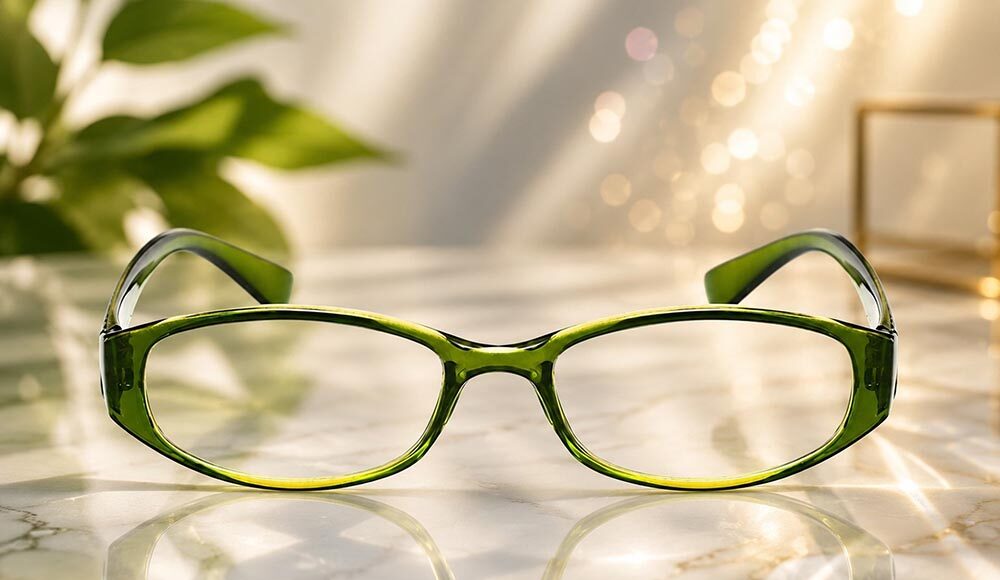
Another important consideration is the colors in the frame. Neutral colors such as black, tortoise and gold are always in style and versatile, while shades of bold colors and patterns provide a more expressive option. Ultimately, the best frame is a perfect fit, that’s comfortable on your nose and ears, and suits you.
Lens Types & Coatings
After selecting the custom frames, the next choice is what type of lenses will you be getting in the frame. Comfort and clarity of vision are strongly influenced by the type of lens material. Most common materials used are polycarbonate, trivex and hi-index plastic. Polycarbonate lenses are light in weight and resistance to impact, suitable for active adults and kids.
The top lenses with higher corrections are thinner and lighter than plastic lenses, particularly useful for those with higher prescriptions. Lens coatings can make your glasses better and/or longer lasting. In addition, anti reflective coatings minimize reflection from computer screens and artificial lights and oncoming headlights, most important for night driving and long periods of computer work.
Scratch resistant coatings give added durability; UV protection coatings protect your eyes from visits from the UV rays of the sun. A photochromic lens such as the brand-name Transitions, helps to darken automatically in the presence of light and can lighten up indoors.
Progressive lenses, also called the “no line” bifocals, offer smoother transition between distance, intermediate, and close-up vision in just one lens. They are especially favored by people who often have difficulty seeing close objects in their old age called presbyopia.
How to Read Your Eyeglass Prescription
The eyeglass prescription may seem intimidating at first glance as it’s loaded with numbers and abbreviations; each one of these contains specific and important information regarding your vision needs. Knowing your prescription opens the door to having more meaningful conversations with your optometrist, and better choices when ordering glasses.
The prescription will normally be broken down into two sections, one for the right eye (OD for Latin “oculus dexter”) and one for the left eye (OS from the Latin “oculus sinister”). OU = both eyes. Sphere and cylinder, axis, and may include add power are the most common values on a prescription.
The sphere is a measurement of the refractive error, or the amount of nearsightedness or farsightedness. If it is negative, then you are nearsighted (myopic) and if it is positive then you are farsighted (hyperopic). The cylinder and axis values are used to tell you if you have astigmatism, which means that the eye’s cornea or lens is aspherical, thus resulting in blurring and distortion of vision.
This add value is written on prescriptions for the person that requires magnification for reading, usually for bifocals and/or progressives. Your pupillary distance (or PD) is also taken, which refers to the distance in between eyes, to ensure that your lenses fit properly in the frames.
What Does DS Mean on an Eye Prescription
DS is one of the abbreviations that is commonly encountered on an eye prescription that can confuse people. When it comes to the question regarding ‘what does ds mean on eye prescription, it’s simple to answer. The first diopter (denominator) number S is labeled “DS” and is placed in the cylinder section of your prescription if there is no correction for astigmatism.
That’s simply to say that if your prescription is what is known as a number plus DS, you should have no cylinder in your prescription correction, only a spherical correction. The lens has the same degree of curvature in any direction, like a round ball rolled out in all directions.
For instance, a prescription that reads “minus 2.00 DS” indicates a spherical lens of minus 2.00 diopters for that eye, no astigmatic correction. This is useful for opticians and lens manufacturers to know, as it is not just missing from the prescription, but a true indication of a 0 cylinder. Understanding DS can prevent miscommunication when ordering glasses online, or when confirming with the optical shop.
Caring for Your Prescription Glasses
Taking care of your glasses can help prolong their lifetime and keep them clear and working properly. The safest way is to clean your lenses on a regular basis, using a microfibre cloth that’s specialized for optical lenses and cleaning spray.
Don’t use paper towels, clothes or cleaners meant for home use because they may inflict damaging scratches on lens coatings and possibly leave scratches and residue on the lens. To prevent the frames and lenses from bending, cracking or getting scratched when not in use, keep them in a hard shell case.
Glasses should be set face up with the lenses up when not in use. Another thing to watch out for is exposure to heat – exposing your glasses to excessive heat can warp frames and damage lens coatings, so be mindful of this.
Loose or misaligned frames should then be adjusted by a professional optician and NOT bent at home. Most Optical shops provide complimentary adjustments and minor repairs, and can help keep your glasses comfortable and fit over time.
Conclusion
Prescription Glasses are so much more than a medical instrument. They are the synthesis of vision science and personal taste and utilitarianism. Whether you’re selecting frames that suit your face shape and way of life, or weighing the technical jargon of your prescription, it’s all an important part of the eyewear journey.
With the help of informed glasses wearers, you can find out the details of every item on your prescription, such as what the abbreviations mean when using glasses as well as to get the most from your eyewear. Good maintenance practices and choosing the right lens, fitting, and pair will make your pair of glasses a great investment that will last you many years.