

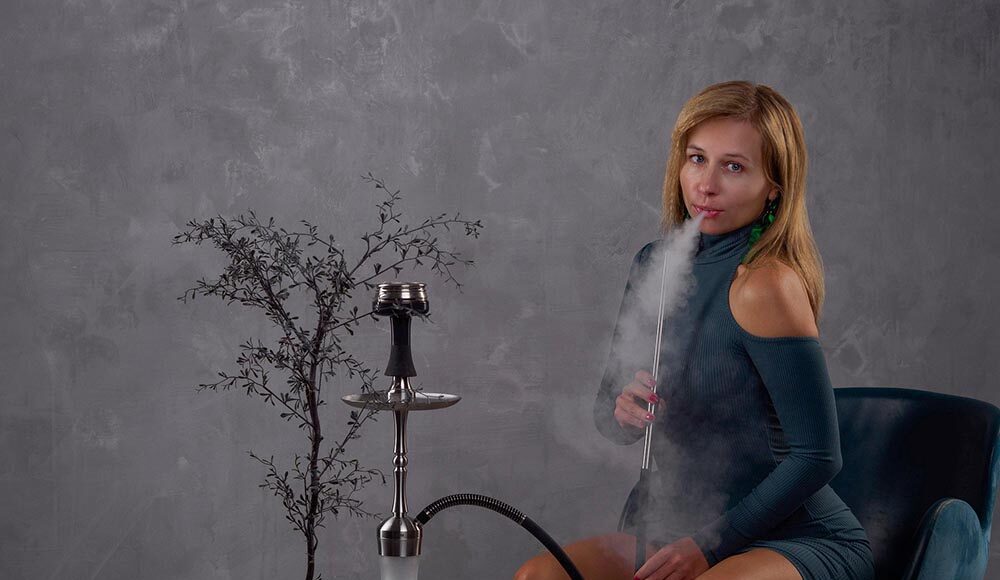
Open the door to an apartment of a particular type and you have a decent bet of locating a hookah in the one room.
Arrive in an apartment where all the furniture is by a certain designer, the bar cart has a vintage touch, and the ceramics are direct from the maker and there’s a high chance that you’ll find some hookah in one of the rooms.
Not in a cabinet but out, so it can be seen when the record player is not in use – a sideboard or somewhere besides a cabinet. The once-known object has transformed into another without anyone noticing, more or less because of the design, more because of the content of the bowl.
A Change in Silhouette
The shape of the hookah remained relatively unchanged throughout the latter part of the 20th century, with its stem usually tall, a bulbous-headed glass at its base that was often decorated with paint or silver, and a long leather wrapped pipe. It was a decorative object, but not a designer object, as is a souvenir.
Things did change in the past decade as a new crop of makers (for the most part, German, Polish, Russian, and in the Gulf) started to approach the hookah in the same way a furniture studio approaches a chair. Stems were transformed from flesh to threads of stainless steel or anodized aluminum, or columns of wood or metal.
From the decorative bases to minimals, clear glass, matte black, smoked clear, etc., and even some just a single color block. Wood or aluminum handles were replaced with silicone in subdued colors, and hoses were replaced with silicone. What it is that the current design vocabulary showcases is something indebted to Scandinavian lighting as well as Italian barware but not to a bazaar, in fact, it’s an object that is considered and in no way exotic.
Material as the Statement
Material is the second shift, in a series of shifts, if silhouette was the first. Walnut and oak stems of Polish ateliers with ‘showing’ grains. Brushed/surgical stainless steel finish. A series of small hand blown glass bases, varying in shape. Carbon fiber, for the car engineers working to achieve the interior appeal of a sports car. Brass is making a comeback as well, and it’s not in a Victorian parlor, it’s in a modern kitchen, but it is dressed up and simplified.
That’s the exact same materials conversation that’s taking place throughout house design, real surfaces, real craft, colour restraint, and it’s why the hookah began to feel like a part of a room that it absolutely wouldn’t in the past. Take a stroll through the current generation of hookahs, and you’ll find they’re a bit more similar to a showroom for light bulbs than you think: little tabletop options under an inch tall for coffee table bases, mid-sized models that will join to a table or stand on its own, and tall sculptural designs meant to be set upon the floor beside a sofa.
Scale and Placement
People who appreciate design like to find a piece based on its scale, as they would with a floor lamp. A small hookah (this type has definitely made a shift to compact models in recent years) is sitting on a side table and being swallowed by the makeup of a room.
Large pieces play a supporting role when sitting on a low coffee table in an evening and return to a bench at other times. The tall objects are statement pieces selected as much for their seemingly unused appearance as for their functionality. With color, the same applies.
A monochromatic look tends to be the strongest, such as a black stem with a black base and hose, as well as using one accent against a neutral color look. That old style has a mixed metal thumby with a range of patterns which the new design language eschewed.
Function Still Leads
It’s not just a visual fashion, though, because the more aesthetically pleasing pieces are, for the most part, the most successful. The transition from wood to steel and stringent specifications for fittings grew out of a passion for air flow and seal from makers, and while clean lines are all about creating engineering, they’re not about decoration.
A good smoke pipe for modern days extracts the tobacco, releases the tar nicely and is easy to clean (hooking sticks of a previous era failed to do this). Hookah Vault’s beginner’s guide to setting up a hookah essentially teaches how it is set up and used for the first time, and most of the design-oriented models are the same.
The Object on the Shelf
Typically homeward bound with objects that started as functional, but have turned expressive: the cast-iron pan, the turntable or the espresso machine. So is the hookah, and for the same reason: a handful of “makers” believed it to be worthy of design, and a wave of “potential users who would like what occupies their shelves to be designed” said “yes.” The outcome is a piece that can stand as a room furnishing and gets the respect it needs when it is used on an evening.