

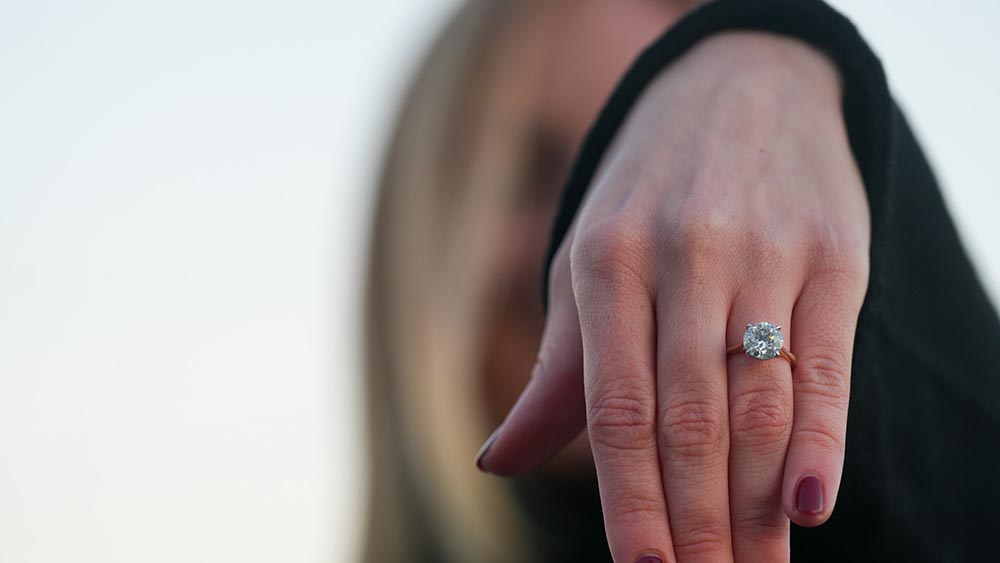
Origins: How Salt and Pepper Diamonds Form
Salt and pepper diamonds are natural gems forged deep within the Earth’s mantle, roughly 150 to 200 kilometers below the surface.
Their creation begins when molten carbon crystallizes under extreme pressure (45 to 60 kilobars) and temperature (900 to 1,300 degrees Celsius)—conditions that also trap trace minerals like graphite, olivine, and garnet. Over millions of years, these foreign particles scatter throughout the diamond’s crystal structure, forming tiny, scattered specks that give the stone its distinctive “salt and pepper” look. Unlike high-clarity white diamonds, which grow with minimal impurities, salt and pepper diamonds wear their inclusions as badges of their natural growth story.
Geologists note that the exact type of inclusion depends on the diamond’s mining location. For example, diamonds from the now-closed Argyle mine in Australia often have dark, prominent graphite specks, while Canadian mined salt and pepper diamonds tend to feature softer, lighter mineral flecks. Each mine’s unique geological conditions produce a slightly different pattern, making every salt and pepper diamond a one-of-a-kind piece of Earth’s history. Some even have inclusions that mimic tiny stars, clouds, or snowflakes—no two stones share the exact same arrangement.
Distinct Characteristics: What Sets Them Apart
The most striking feature of salt and pepper diamonds is their texture: a blend of gray hues, from misty light ash to deep charcoal, dotted with white and black specks. This color comes from trapped minerals, not chemical treatments, unlike fancy colored diamonds such as pink or yellow stones. The density of specks varies widely: “light salt” diamonds have fine, evenly spaced flecks that feel subtle, while “dark pepper” diamonds have larger, bolder black spots that create a dramatic, almost opaque look.
Clarity grading for salt and pepper diamonds differs from traditional diamond standards. Traditional gems are scored from Flawless to Included, where “Included” is a negative, but salt and pepper diamonds are often graded as Included or Very Included—and this is a selling point. A 1.5-carat cushion-cut salt and pepper diamond I saw at a New York boutique last year had a cluster of tiny black specks near its center, which the designer called “its own little secret story.” For consumers, these inclusions add depth and personality, rather than being flaws to hide.
Cutting is tailored to highlight these unique patterns. Common cuts include cushion, round, pear, and emerald, as their facets spread specks across the stone’s surface. A round-cut salt and pepper diamond, for instance, has a halo of white flecks around its edge, while a cushion cut (with rounded corners) lets the inclusions blend into a soft, vintage mist. Some cutters even leave small unpolished areas to preserve the stone’s raw, natural feel, rejecting the sharp symmetry of traditional white diamond cuts.
Rise in Popularity: From Niche Gems to Mainstream Favorites
Just a decade ago, salt and pepper diamonds were overlooked, seen as “imperfect” and less valuable than white diamonds. Today, they’re a mainstream favorite, driven by shifts toward sustainability, individuality, and anti-mainstream aesthetics. Millennials and Gen Z are moving away from generic white diamond engagement rings, craving pieces that reflect their unique style and values.
A clear example is the brand Catbird, which launched its 2022 Unfiltered Collection focused solely on salt and pepper diamonds. Their 2023 sales report shows engagement rings with these gems made up 25% of total sales, up from just 8% in 2021. Catbird’s design director Emma Fox says customers often tell her, “I don’t want a ring that looks like my friend’s—this one feels like me.” Another brand, Jacquie Aiche, sold out of its 2023 Bohemian Rhapsody salt and pepper line in three weeks. Even Vogue’s 2023 celebrity engagement ring roundup featured salt and pepper diamonds in 12% of entries, up from 2% in 2019.
Sustainability is a key driver. Most salt and pepper diamonds are mined with low-impact methods, and nearly all are untreated—unlike many white diamonds, which undergo laser drilling or fracture filling to hide inclusions. A 2022 Jewelers of America survey found 62% of young buyers prioritize sustainability when choosing jewelry, and salt and pepper diamonds align perfectly with this value. Eco-conscious shoppers also appreciate that each stone has a smaller environmental footprint than processed gems.
Care and Durability: Practical for Everyday Wear
A common question: Are salt and pepper diamonds tough enough for daily use? The answer is yes—they share a Mohs hardness score of 10 with all diamonds, meaning they’re nearly scratch-proof. Their inclusions are solid mineral particles, not structural cracks, so they don’t weaken the stone. This makes them ideal for people with active lifestyles, like teachers, construction workers, or parents.
Take Sarah and Mike, a Chicago couple who bought a 1.2-carat cushion-cut salt and pepper ring in 2018. Sarah is an elementary school teacher handling chalk and art supplies daily, while Mike works construction. Five years later, their ring has only a few tiny scratches on the band, and the diamond looks identical to day one. Sarah says, “I worried the inclusions would make it fragile, but it’s just as tough as my friend’s white diamond.”
Basic care mirrors white diamonds: warm water, mild dish soap, and a soft brush for cleaning—avoid harsh chemicals or ultrasonic cleaners, which can damage settings. Professional cleaning every six months ensures the setting is secure. Unlike white diamonds, there’s no need to obsess over every tiny spot; the specks are part of the charm. Even if a speck is slightly off, it adds to the stone’s unique character.
How to Choose Your Perfect Salt and Pepper Diamond
Choosing a salt and pepper diamond is a personal, fun process. First, decide on inclusion density: light salt for subtlety, dark pepper for drama. Light salt works well for those who want elegance without flash, while dark pepper stands out in statement pieces. I once helped a client pick a light salt round diamond for her engagement ring; she loved that it looked like a misty gray moon under natural light, not a generic white stone.
Next, pick a cut that matches your style. Cushion cuts are romantic and vintage, perfect for halo settings. Round cuts are versatile, fitting solitaire or halo designs. Pear cuts add a delicate, flattering touch to the finger. For an engagement ring, a solitaire cushion cut is a top choice, as it lets the inclusion pattern take center stage.
Budget is another win: salt and pepper diamonds cost 30-50% less than same-size white diamonds. A 1-carat salt and pepper ring runs $500-$1,500, vs. $2,000-$5,000 for a comparable white stone. Always confirm the diamond is untreated—most are, but it’s a key detail for value and authenticity. View the stone in natural light; artificial light can skew the speck pattern, so seeing it in sunlight or a well-lit room shows its true beauty.
Finally, trust your gut. The best salt and pepper diamond is the one that makes you smile. Whether it’s a small, delicate stone or a bold, large one, its uniqueness is its greatest strength. Many jewelers offer custom settings to pair with your diamond, so you can create a piece that’s truly yours—something that tells your story, not a generic one.