

Fashion retail has always understood the power of a moment.
A runway entrance, a window display, a fitting room reveal — shopping has never been only about clothes. It has always been about emotion, aspiration, and the spark that makes someone feel connected to a brand.
But the way shoppers experience those moments is changing.
Today, customers move between digital and physical worlds without thinking about it. They discover trends on TikTok, compare products online, save outfits on Instagram, and enter stores expecting that same sense of speed, personalization, and play. A beautiful store still matters, but beauty alone is no longer enough. The modern fashion space has to respond.
This is where immersive retail comes in.
Rather than treating the store as a static showroom, brands are beginning to turn it into a living experience: one where shoppers can try, personalize, create, and share. Technologies like AI mirrors, AR mirrors, AR storefronts, and AR photobooths are becoming part of this shift — not as gimmicks, but as tools that make physical retail feel more relevant in a digital-first culture.
From Looking to Participating
For decades, fashion retail was built around presentation. Products were styled, displayed, and arranged for shoppers to observe. The customer’s role was mostly passive.
That model feels increasingly out of sync with how people interact with fashion today.
Shoppers are used to filters, recommendations, digital styling, instant comparison, and endless choice. They do not just want to see a collection. They want to enter it.
In that sense, immersive retail is less about adding technology to stores and more about updating the role of the store itself.
The best fashion spaces are no longer designed only to display products. They are designed to activate people.
Why Static Stores Are Losing Attention
Static retail does not fail because it is unattractive. Many stores are still beautifully designed. The problem is that beauty becomes background when nothing invites interaction.
Modern shoppers are selective with attention. They need a reason to pause.
At the same time, shopping behavior is increasingly shaped by digital and social environments. Social commerce alone is projected to approach $80 billion in the U.S., reflecting how closely shopping, content, and entertainment are now connected. Physical retail is no longer competing only with nearby stores — it is competing with the entire digital ecosystem.
Immersive retail gives brands a way to respond. Instead of simply walking past a display, the shopper can try on a look virtually, generate content, or explore products dynamically.
That small shift — from observation to participation — changes everything.
AI Mirrors and the New Fitting Room
One of the clearest examples of this shift is the rise of the AI mirror for clothing try-on.
The fitting room has always been where desire becomes a decision. But it is also one of the most limited parts of the retail journey.
AI mirrors can make that process faster and more fluid.
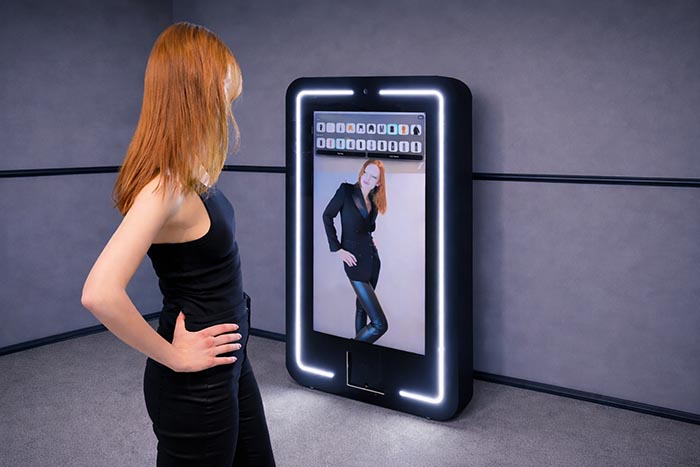
With real-time virtual clothing try-on, shoppers can see themselves in multiple looks without changing each item manually. They can compare styles, explore more options, and move through collections with less friction.
When AI is layered in, the experience becomes more intelligent — suggesting combinations, guiding discovery, and adapting to user behavior.
This matters because personalization directly impacts business outcomes. According to McKinsey, personalization can increase revenue by 5–15% and improve marketing efficiency significantly. AI mirrors bring that logic into the physical store.
The result is not just a more “high-tech” fitting room — it is a more effective one.
AR Photobooths and the Store as a Media Channel
Not every retail experience is about immediate conversion. Some of the most valuable moments are about engagement, emotion, and visibility.
This is where AR photobooths come in.
They turn retail spaces into content environments, where visitors can create and share branded experiences. In a culture where identity is social, this matters.
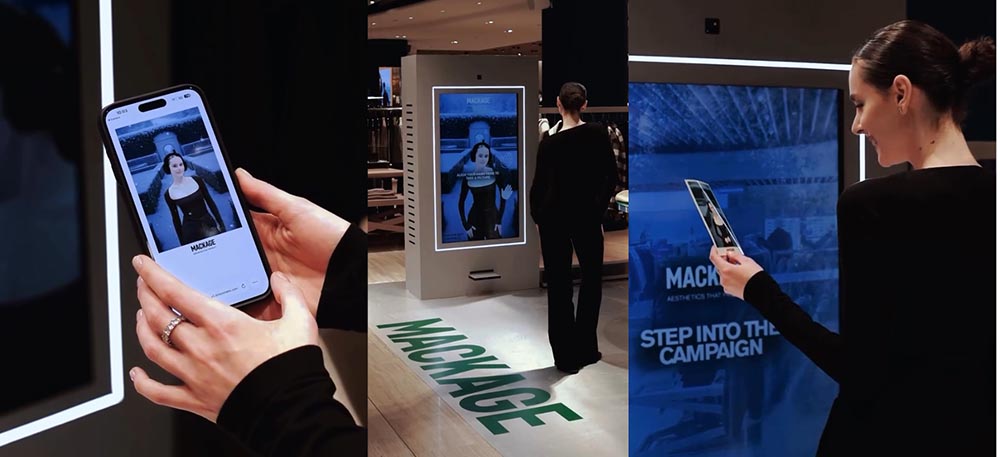
For Mackage at Holt Renfrew, an AR Mirror Photo Booth created a winter-themed experience with snowfall effects and interactive visuals. Over 19 days, it generated 2,444 activations, with an average interaction time of around 50 seconds.
These interactions do not just stay in-store. They extend into social media, where user-generated content plays a major role in influencing behavior. According to Nielsen, 88% of consumers trust recommendations from people they know more than any other form of advertising — which is why shareable experiences have such a strong impact.
AR Mirrors as a Bridge Between Product and Imagination
While AI brings intelligence, AR mirrors bring immediacy.
They allow shoppers to see digital fashion elements layered onto their reflection in real time, turning product discovery into a visual experience.
This is especially powerful in categories where appearance drives decision-making. It also helps overcome one of retail’s biggest limitations: inventory.
Instead of relying only on what is physically available, shoppers can explore extended options digitally. This kind of visual interaction has a measurable impact — Shopify has reported that products presented with 3D or AR content can see conversion rates increase by up to 94%.
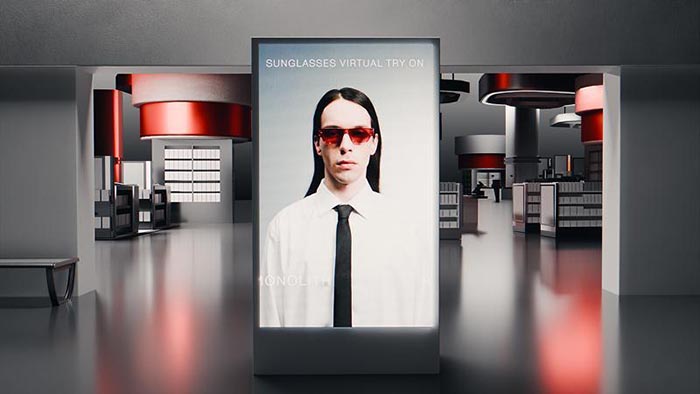
A strong real-world example comes from Fendi Travel Retail, where an AR mirror was installed for a sunglasses activation at Istanbul Airport. Travelers could try on products hands-free and receive instant printed photos. The activation generated 400+ photos, supported a sell-out of the collection, and delivered 43% year-over-year sales growth compared to the non-AR version.
A shopper may forget a display. They are far less likely to forget seeing themselves inside it.
AR Storefronts and the Street as a Retail Stage
Immersive retail does not begin at the door — it often starts on the street.
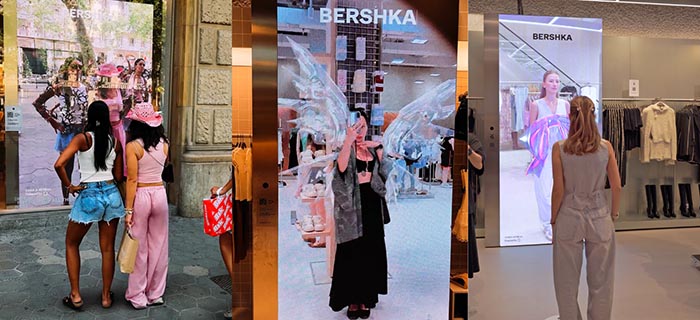
For Bershka Barcelona, AR mirrors were installed both inside the store and in the storefront, allowing passersby to interact with digital fashion elements in real time. The activation generated 8,200+ interactions in one week, with around 1,100 daily engagements.
This changes the role of the storefront entirely.
Instead of being a passive display, it becomes an active touchpoint — something that captures attention, invites participation, and drives foot traffic inside.
The Business Case Behind the Immersive Retail Experience
Immersive retail is often described in terms of experience, but its value is increasingly measurable.
AI mirrors support faster decision-making and higher purchase confidence.
AR mirrors increase engagement and product exploration.
AR photobooths generate content and extend reach beyond the store.
AR storefronts convert attention into interaction.
At the same time, these technologies provide something traditional retail often lacks: data.Brands can track engagement, interaction time, product interest, and participation — turning physical retail into a more measurable, optimizable environment.
Interactive Retail Technology in Practice
One of the companies working at the intersection of fashion, AI, and immersive retail is loook.ai. Its platform turns existing screens into interactive AI and AR mirrors, allowing brands to deploy virtual try-on, smart styling, and AR-driven experiences across stores, storefronts, and events without complex hardware setups. From AI-powered clothing try-on to AR photobooths and interactive windows, the system is designed to make physical retail more engaging and measurable — helping brands increase foot traffic, extend product discovery beyond physical inventory, and generate real-time insights from in-store interactions.
The Future Store Will Not Be Static
The future of fashion retail is not about adding technology everywhere. It is about using it where it creates value.
A luxury brand may use AR to deepen storytelling.
A fashion retailer may use AI mirrors to improve try-on.
A pop-up may use AR photobooths to drive engagement and visibility.
The format will vary, but the direction is consistent.
Static retail asked customers to look. Interactive fashion retail invites them to participate.
And in a world where attention is the most valuable currency, that difference defines which stores people remember — and which ones they walk past.