

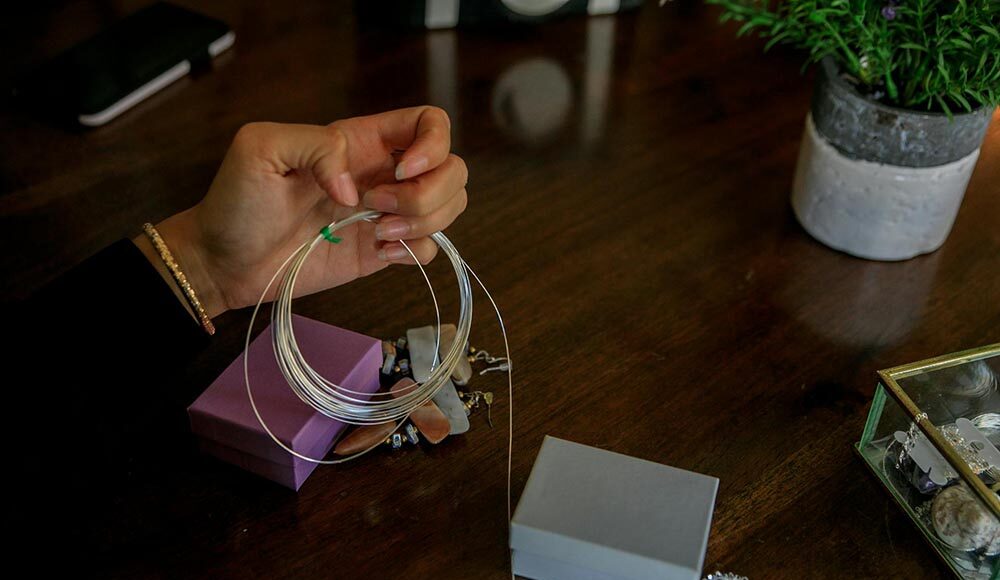
Stainless steel wire has become the go-to material for professional jewellery work.
Understanding what separates it from every other beading option is key. Whether you’re stringing heavy gemstones, making multi-strand pieces or simply need something that holds its shape through daily wear, steel wire delivers what cord cannot. Here’s what you need to know, using GRIFFIN’s professional range as the reference.
What Makes Stainless Steel Wire Different from Other Beading Materials
Bead cord such as silk, nylon, cotton is textile. It stretches slightly, knots between beads and falls with the characteristic drape of traditional pearl jewellery. Stainless steel wire is a different category with properties cord doesn’t have.
Steel is inherently stronger than any fibre at equivalent diameters. A 0.35mm stainless steel wire carries loads that would require a much larger silk or nylon cord to match. This strength advantage means wire-strung pieces handle heavier beads, resist drill-hole abrasion over longer periods and terminate securely with crimp components instead of relying on knots.
Wire also holds its form instead of draping freely. That’s an advantage for designs where bead positioning needs to stay consistent, and a consideration for designs where a cord’s natural fall matters. For most gemstone and bead work that needs to hold its shape through active wear, wire is the stronger choice.
GRIFFIN Jewelry Wire: HiFlex Nylon Coating Explained
GRIFFIN Jewelry Wire is twisted miniature stainless steel strands encased in a HiFlex nylon coating. This coating is what separates professional beading wire from bare steel, and it does multiple things at once.
Skin comfort: Bare stainless steel against skin feels hard, cold and catches on clothing. The HiFlex nylon layer feels smooth and soft – similar to a quality cord when worn at the neck or wrist.
Protection: The nylon layer encloses the steel core, preventing contact with skin oils, moisture and cosmetics. This extends the wire’s working life versus uncoated alternatives.
Knotability: Because the outer surface is nylon rather than bare metal, GRIFFIN Jewelry Wire can be knotted – something bare steel wire cannot do. Simple overhand knots hold reliably on the nylon surface.
Break-proof performance: The combined construction of steel core and protective nylon sheath delivers the break-proof durability GRIFFIN confirms for its range.
Four surface variants are available: Clear 19-strand (general purpose), Clear 49-strand (professional quality, no corkscrew effect), Silver Plated (7 micron 925 sterling silver) and 24K Gold Plated (7 micron). All come in six diameters from 0.25mm to 0.60mm.
19 Strand vs 49 Strand: Practical Differences for Jewellery Makers
The strand count refers to the number of individual steel filaments twisted to form the core. This number directly affects the wire’s flexibility and how it behaves in your hands.
19-strand wire: Nineteen steel strands produce a capable wire with good flexibility for standard jewellery. Use it for everyday gemstone necklaces, beaded designs and most wire-strung work that doesn’t place extreme flexibility demands on the material. It’s also more economical, appropriate for production-volume work.
49-strand wire: Forty-nine ultra-fine strands produce dramatically superior flexibility – a wire that handles closer to cord than to conventional steel. Two specific advantages: the drape is noticeably more natural, allowing finished necklaces to lie flat against the collarbone rather than holding a stiff arc. Second, GRIFFIN highlights the absence of corkscrew effect – the wire doesn’t develop spiral memory after bending around a clasp or neckline, which is one of the most visible quality failures in wire-strung jewellery.
For commission work and designs where the finished piece’s drape will be directly assessed, 49-strand justifies the price premium. For standard production work and practice, 19-strand performs reliably at lower cost.
Working with GRIFFIN Stainless Steel Wire: Practical Tips
- Use proper wire cutters: Scissors crush the strands rather than cutting cleanly. Flush cutters produce the clean end required for threading through crimp components.
- Test the doubled wire fit before starting: The wire loops through the clasp and back through the crimp, creating a doubled configuration inside the tube. Test that this doubled length passes through your crimp with slight resistance before committing to the full strand.
- Leave a 3cm to 4cm wire tail: After threading through the clasp and back through the crimp, leave enough tail to thread through the first two to three beads after crimping. This hides the tail without creating visible bulk.
- Avoid sharp bends: Kinking the wire weakens the steel strands at the bend. Work in smooth curves throughout construction.
- Handle plated wire with clean hands: The silver and gold plated variants have a 7-micron surface coating that’s durable but not indestructible. Handle with dry, clean hands and use padded-jaw pliers where wire contact is unavoidable.
- Match wire to clasp metal: Silver plated wire uses silver findings; gold plated wire uses gold findings. Mixing metal tones reads as a mistake rather than a design choice.
Pairing GRIFFIN Wire with GRIFFIN Crimp Tubes
The professional finish for GRIFFIN Jewelry Wire is the two-stage crimp technique using GRIFFIN Crimp Tubes and the GRIFFIN Bead Crimper. This produces a rounded, bead-like finish at the clasp attachment that’s secure and clean.
Stage 1 – Folding: Place the doubled-wire crimp tube in the inner oval notch of the GRIFFIN Bead Crimper. Close firmly to create a centre fold that separates the two wire strands into separate channels within the tube. This mechanical separation is what gives the crimp its grip.
Stage 2 – Rounding: Rotate the folded tube 90 degrees and move it to the outer rounded notch. Close to fold the tube back on itself into a compact, rounded cylinder. The result looks like a standard round bead in profile.
Test by pulling the wire firmly in both directions. A correctly applied crimp doesn’t move under normal hand strength. If it moves, repeat Stage 1 with more pressure. Match crimp metal to wire surface: 925 silver crimps for silver or clear wire with silver findings; 24K gold crimps for gold plated wire.
Frequently Asked Questions
- What is the difference between 19-strand and 49-strand beading wire?
19-strand wire has 19 steel filaments in the core and suits standard jewellery work. 49-strand has 49 ultra-fine filaments, producing significantly greater flexibility, better draping and no corkscrew memory effect after bending – making it the professional choice for high-quality pieces. - Why does stainless steel jewelry wire have a nylon coating?
The nylon coating (HiFlex in GRIFFIN’s case) makes the wire comfortable against skin, protects the steel core from moisture and cosmetics and allows the wire to be knotted. Bare steel would be stiff, hard against skin and prone to rusting. - What tools do I need to work with stainless steel beading wire?
Flush cutters for clean ends, flat-nose pliers for holding wire and jump rings, and a dedicated bead crimper for the two-stage crimp technique. The GRIFFIN Bead Crimper is specifically designed for use with GRIFFIN Crimp Tubes and produces a professional rounded finish. - Can stainless steel beading wire be knotted?
GRIFFIN Jewelry Wire can be knotted because the outer HiFlex nylon surface provides friction for overhand knots to hold. This property comes from the nylon coating, not from bare steel, which cannot be reliably knotted. - What diameters does GRIFFIN Jewelry Wire come in?
GRIFFIN Jewelry Wire is available in six diameters: 0.25mm, 0.30mm, 0.35mm, 0.45mm, 0.50mm and 0.60mm. Finer diameters work for lightweight designs; heavier diameters suit dense or heavy gemstone work.