
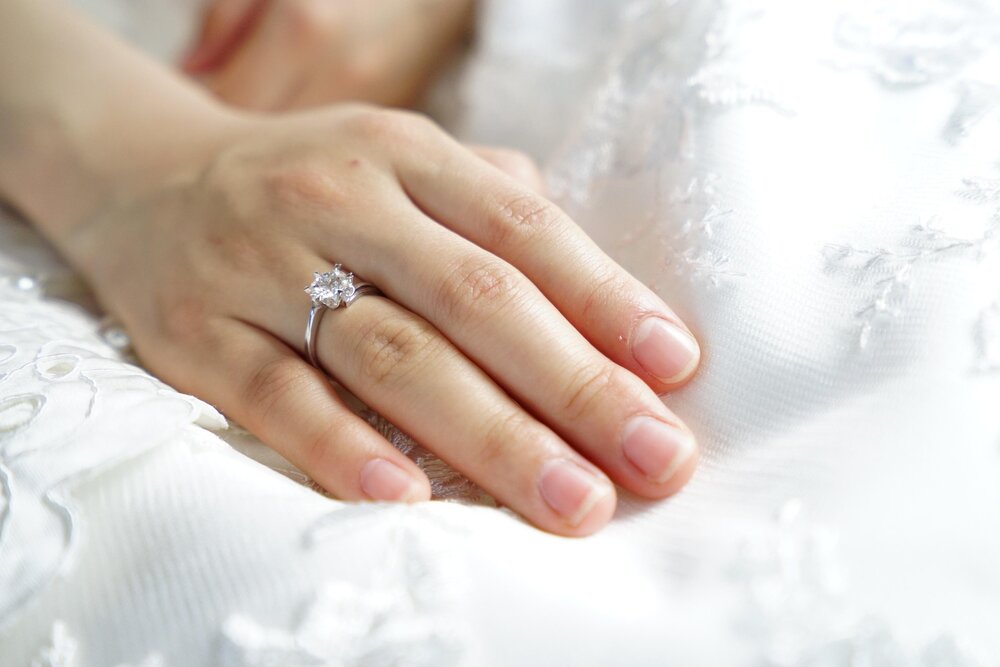
A ring can look perfect on a screen. Big sparkle, clean lines, not a flaw anywhere.
Then you put the same ring on your own hand and something feels off. The stone looks smaller. The band feels wider. It happens more often than people admit.
That is not the ring’s fault, and it is not yours either. Hands are different. Fingers are different. A photograph cannot tell you any of that. Your hand can, in about ten seconds.
Photos Only Tell Half the Story
Jewelry photos are taken up close, under strong lights, usually on a model’s hand that was picked because rings look good on it. Your hand has its own proportions. A design that looks delicate in a photo can feel chunky on a shorter finger, and a bold style that looks like too much online can look completely right when it is sitting on your hand.
Even the famous rings you see in pictures work this way. When celebrities flash their diamond rings at big events, the photos are all sparkle and size. On a real hand, on an ordinary Tuesday, the same kind of ring can feel like a completely different piece.
Size Is Trickier Than It Sounds
Most people think ring size is one fixed number. It is not, not really. Your fingers swell a little in the heat and shrink in the cold. They are slightly bigger in the evening than in the morning. A ring that slides on easily at noon might fight you at eight in the evening.
Knuckles matter too. If your knuckle is wider than the base of your finger, the ring has to get past the knuckle first and still sit snug below it. You only learn that balance by wearing the ring for a few minutes. Walk around with it. Make a fist. Wash your hands. A size chart tells you none of this.
The Height Problem
Here is something almost nobody warns you about: how high the diamond sits. Tall settings look dramatic, and they do catch the light beautifully. They also catch on sweater cuffs, gloves, coat pockets and car doors.
If you type all day, cook a lot, or work with your hands, a high setting can go from beautiful to annoying in about a week. Trying a ring on and actually using your hand for a minute tells you more than an hour of reading descriptions.
Light Changes Everything
Jewelry stores are lit like stages. Those bright spotlights exist to make diamonds throw fire, and they do their job well. The trouble is, you will not live under those lights.
Take the ring over to the window if the store allows it. Look at it in plain daylight, then step away from the counter into softer light. Some stones stay bright everywhere. Others go quiet the moment the spotlights are gone. Better to find that out in the store than at your kitchen table.
Try It With a Wedding Band
When you choose an engagement ring, the stone gets all the attention. Fair enough. But if you will wear a wedding band next to it every day, try the two together before you decide anything.
Some pairs sit flush and look like they were made for each other. Others leave an awkward gap, or the band rubs against the setting. Neither is wrong. Plenty of people happily wear a small gap. But it is much nicer to choose it than to discover it later.
Can’t Try One On? Do This Instead
Sometimes there is no store nearby, or the ring you love is only sold online. It happens. Then borrow the idea of a try-on in smaller ways.
Get a cheap ring sizer and measure at different times of day. Watch videos of the ring on a real hand instead of only studio photos, because movement shows the height and width in a way still pictures never do. Read the return policy before you pay, the whole thing. And scroll through celebrity engagement rings for shape ideas if you enjoy it, just remember they are a starting point, not a fitting.
The Ring Has to Fit Your Life
In the end, an engagement ring is not a photograph. It is a thing you will wear while cooking, driving, working, and holding hands in cold weather. It should look good in all of that, not just in a product picture.
So if you can, try the ring on. Ten minutes on your hand will teach you things no description, review or photo ever could.