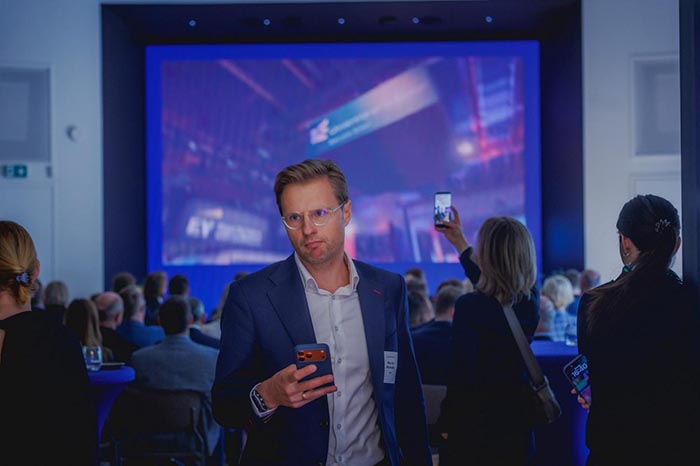
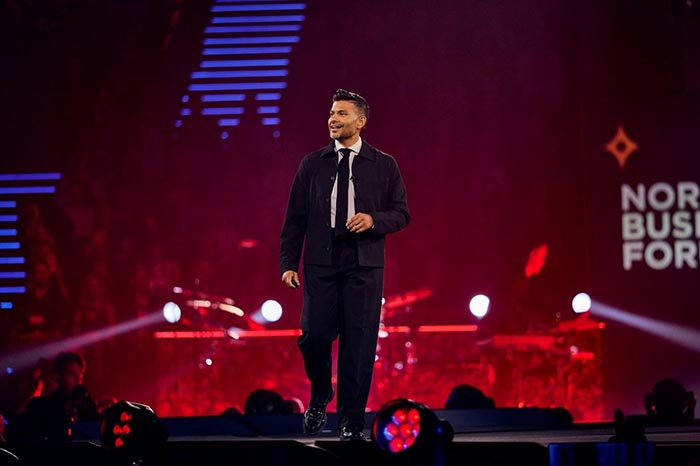
As luxury brands continue to explore the role of artificial intelligence across design, marketing, and customer experience, innovation strategist and bestselling author Shawn Kanungo offered a thought-provoking perspective during his keynote at Nordic Business Forum 2026.
As artificial intelligence rapidly transforms how businesses operate, he argued that the greatest competitive advantage will not come from automation itself, but from distinctly human qualities such as judgment, taste, and creativity.
Kanungo described AI as an engine of conventional wisdom. While autonomous systems are becoming increasingly capable of executing tasks, analyzing information, and optimizing workflows, they are fundamentally built on existing patterns. The role of leaders, he argued, is to ask the questions machines cannot ask and make the decisions algorithms cannot make. “What is power today is judgment,” he told the audience.

For luxury brands, this idea carries particular relevance.
One of the most compelling sections of Kanungo’s keynote focused on what he called the power of intentional friction. As digital experiences become increasingly instant and effortless, businesses face a choice: compete through speed and automation or create value through meaningful human interaction. He cited luxury houses such as Hermès as examples of brands that succeed by embracing craftsmanship, exclusivity, and personal connection rather than pursuing complete frictionlessness.
According to Kanungo, companies that fall between those two models risk entering what he described as the “black hole of mediocrity.” They are neither as efficient as highly automated platforms nor as memorable as businesses built around exceptional human experiences.
The distinction is especially important for fashion and luxury, where emotional engagement often matters as much as the product itself. Kanungo noted that while administrative processes and data workflows should become increasingly autonomous, customer relationships, creative direction, and moments of care gain value through deliberate human connection.
He also demonstrated how autonomous agents can dramatically accelerate creative and business processes, including reimagining and personalizing the marketing footprint of a design house in a matter of minutes. Yet his broader point was not that AI should replace creativity, but that it should free people to focus on higher-value contributions.
As luxury brands navigate the next wave of technological transformation, Kanungo’s message was clear: automate the routine, but protect the human elements that create meaning. In a world where technology is becoming accessible to everyone, judgment, taste, storytelling, craftsmanship, and authentic relationships may be the most valuable luxuries of all.