
You already know that the carpet is the last ninety minutes of something that took nine days.
The crates that came in from Paris with their own handler. The second pull that arrived after the first one was quietly reassigned. The pair of shoes that travelled separately and the necklace that came with a courier and a man who did not sit down. By the time anyone is dressed, the week has already happened somewhere, and where it happens determines almost everything about how it goes.
Beverly Hills has absorbed that week for decades, which is not the same as saying the hotels have. The suites are still beautiful and still full, and there is a kind of visitor for whom a bungalow is the correct answer. But the teams that arrive with racks, and increasingly the people arriving with their own camera and their own deliverables, have moved above Sunset and into houses. The reason is architectural before it is anything else.
Flats and Canyons
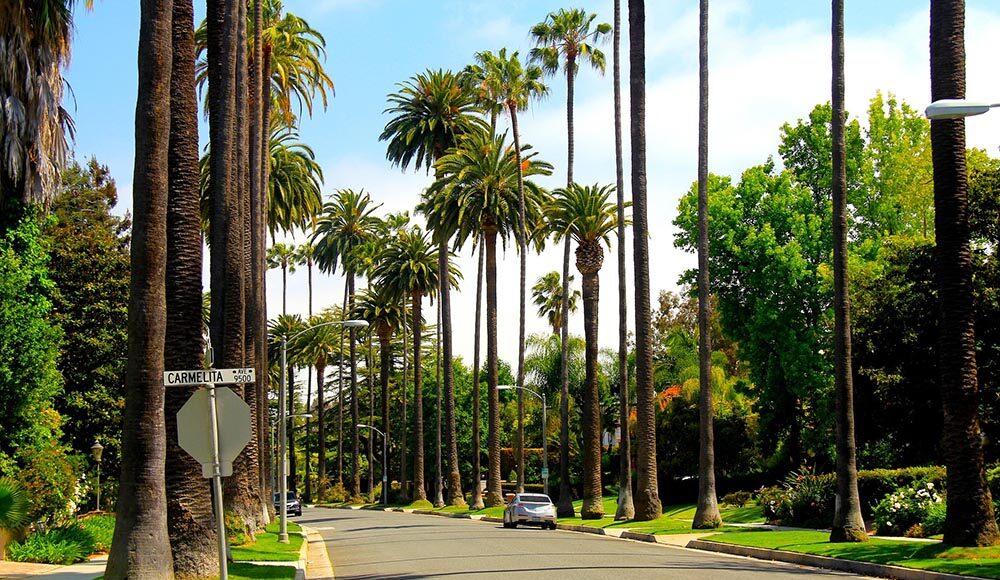
The city divides at Sunset, and the two halves produce two different weeks. Below it, the Flats run on a wide grid with flat sidewalks, deep canopies, and lots that hold a motor court without apology. It is the walkable half, and during the weeks when the surrounding blocks are closed, walking to Rodeo rather than negotiating a valet line is worth more than any amenity a hotel can put on a list.
Above Sunset the streets climb and the houses change character. Trousdale was cut into the hillside in the 1950s and built low: glass walls, long horizontal rooflines, rooms conceived from the first drawing to be photographed. Benedict and Coldwater go further up and trade minutes for grounds, hedges, and the specific quiet that only elevation buys. The Flats give you a schedule you can walk on. The canyons give you a house with no sightlines into it and a terrace that reads as a set without being dressed as one.
Light You Can Trust
A fitting room is a technical space wearing a beautiful one. It needs twelve feet of clearance, because a hem that reads correctly at arm’s length does not necessarily read at distance, and it needs light that does not lie about fabric. North light or a long wall of glass facing away from the afternoon is the difference between approving a look and approving a photograph of a look.
This is where the midcentury stock above Sunset turns out to be unreasonably good at a job it was never given. The houses were built around glass, with rooms that run into one another and wall length enough to hang a season without doubling anything up. A house designed in 1958 to be looked at still knows exactly what to do in front of a lens.
The Getting Ready Is the Deliverable
The other thing that has changed, and that no hotel floor plan has caught up with, is that the preparation is now content in its own right. The sequence from empty rack to finished look is often the most viewed thing anyone produces that week, and it has to be shot in the same house where three other people are working.
That requires more than a pretty room. It requires a wall that is not busy, a staircase or a hallway that gives depth, a mirror that can be shot into without catching the steamer and the garment bags behind it, and somewhere the light arrives late and low enough to carry a golden hour frame at the exact moment everyone is being zipped. It requires a room that can be closed off and kept clean while the rest of the house descends into the usual controlled disaster. Anyone shooting brand deliverables during an awards week is running two productions at once, and only one of them ends on the carpet.
Four in the Morning
Event days start in the dark. Glam calls at four or five, a kitchen running before dawn, a second bathroom nobody is competing for, and a room where three people can work without waking whoever is not needed yet. By then the house has taken its shape: one room for hair, one for the racks, one where the publicist is on the phone with her shoes off and the call sheet on the counter.
This is the case for private villas in Beverly Hill rather than a room category and a floor plan you cannot alter. A dining room becomes a fitting room for six days. A pool house becomes a second station and, on the right afternoon, the best backdrop in the house. A gated motor court means a look travels from van to front door without crossing a lobby, which is a question of insurance long before it is a question of discretion.
Hedges and Sightlines
Privacy here is structural rather than promised. The hedges are permitted to be that tall, the courts were gated in the 1960s for clients with precisely this problem, and a house at the end of a canyon cul-de-sac has no adjoining room, no shared corridor, and nobody stationed across the street. Borrowed jewellery stays overnight in a house more comfortably than it stays in a suite, and everyone who has signed for a piece understands why.
It is also what makes hosting possible on your own terms. Fourteen at a table,a private chef in the kitchen, the basin going violet at eight, and the looks upstairs untouched on their racks. That night exists only if you decide it does, which is the whole point.
The Season Has a Shape
The calendar compresses. January opens. February is the dense stretch, when Frieze, the pre-Oscar circuit, and a fortnight of fittings overlap so completely that one long stay is more sensible than three arrivals. Early spring closes the run, and September belongs to the Emmys, which pull the schedule east while still filling the Westside.
The houses for those windows go early, usually before nominations are public, to the teams who book on speculation. When the date itself is not yet confirmed, flexible terms are worth more than a fifth bedroom.
Between Fittings
The hours in the middle deserve their own planning. Beverly Gardens Park runs along the north side of Santa Monica Boulevard and is the best walk available for clearing a head between appointments. Greystone, up in the hills, is a public garden you have already seen in a dozen films and half as many campaigns. Rodeo is three long blocks between Wilshire and Santa Monica, appointment-only at the top end, and best walked before the season closes the streets.
Choreography, Not Improvisation
The habit worth taking from the people who do this for a living is to stop thinking at night. A style week is a base of operations with events attached, and the base decides everything downstream: how the looks arrive, where they hang, who gets the good light at five in the morning, what the getting ready footage looks like, how far anyone has to travel in something that does not bend, and whether a chauffeured car is already waiting in the motor court when it is time to leave. Choose the house first, in the half of Beverly Hills that matches the schedule, and the rest of the week becomes choreography.