

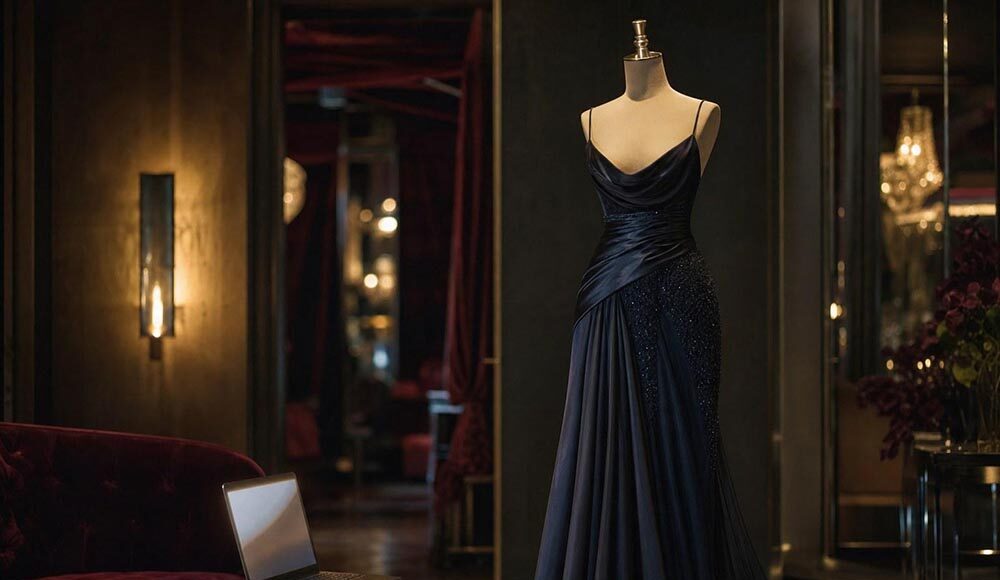
There was a version of casino night that never involved a casino at all. It involved a dress.
Sequins that caught the light differently depending on which way you turned, a clutch too small to hold anything but a phone and a lipstick, heels chosen for how they photographed rather than how they felt after 11pm. The casino, in that fantasy, was mostly a backdrop. It gave the outfit somewhere to be seen.
That fantasy did not come from nowhere. Mid-century Vegas built an entire visual language around the idea that gambling was an occasion, and film kept it alive long after the smoking lounges and orchestra pits went out of fashion. Bond at a baccarat table. Ocean’s Eleven walking into the Bellagio like they owned the marble. The clothes did as much work as the plot. A casino floor was one of the last places where formalwear had an obvious, unembarrassed reason to exist, and stylists treated it accordingly, which is part of why guides on how to dress for a night of casino glamour and elegance still circulate long after most gambling moved off the floor.
Real casinos, it turns out, mostly let that reputation do the marketing for them. Away from the awards-season imagery, dress codes at land-based casinos have been sliding toward “no athletic wear, no swimwear” for years, and high-roller rooms are a small, curated exception rather than the rule. The tuxedo at the roulette wheel was always more myth than Tuesday night. Still, the myth mattered, because it gave an entire category of eveningwear a stage to perform on.
The dress code that survived the building
So what’s left of casino glamour once a meaningful share of casino play happens on a phone at a kitchen table? More than you’d expect, just relocated. The visual grammar of casino glamour, jewel tones, metallics, a certain deliberate excess, hasn’t disappeared from culture. It’s migrated into places that have nothing to do with gambling at all: gala dressing, red-carpet styling, the kind of evening pieces that get built for one specific night and then hung at the back of a closet. Crystal minaudières and heavy-cut gowns still sell. They’re just sold on the promise of a benefit dinner or an awards ceremony rather than a night at the tables.
That’s not a coincidence. Casino glamour, stripped of the actual casino, was always really about occasion dressing, about clothes that announce that tonight is different from other nights. Once the gambling itself stopped requiring a physical room, the aesthetic kept its independence. It’s why a search for “casino chic” still returns styling guides aimed at people who have never set foot on a gaming floor and have no plans to, sitting alongside pieces on evening dress codes for high-end nights out that never mention a casino at all. The look outlived the errand that used to justify it.
Online play has, in its own way, replaced one kind of ritual with another. There’s still a moment of getting ready, choosing an environment, deciding this session deserves the good glass rather than whatever mug was closest. It’s a smaller ritual, and a quieter one, but the impulse behind it, treating an evening of play as an evening rather than a task, hasn’t gone anywhere. It’s just been re-scaled to a living room instead of a casino floor.
That distinction is worth sitting with, because it says something about where the “occasion” now lives. It isn’t the venue anymore, since the venue is a browser tab. It’s the framework around the venue: whether the operator is licensed, whether deposit and time limits exist from day one, whether there’s somewhere to turn if play stops feeling like fun. CTV News covered Alberta’s recent market’s opening with an emphasis on exactly that, the shift from an unregulated grey market to one with published rules attached. Anyone curious about how that framework actually shakes out in practice, which operators launched, what the licensing terms look like, can find recent research on Alberta’s online casinos that lays out the details rather than the marketing copy. None of that changes the outfit question, but it does answer a different one: what, exactly, a person is opting into when they choose to play from home instead of grey-market alternatives.
Dressing for an audience of one
The most honest thing to say about casino glamour in 2026 is that it’s become optional in a way it never quite was when the casino was a physical destination you had to be let into. Nobody is turned away from an online table for wearing the wrong shoes. That’s a loss for a certain kind of theatre, and also, for most people most nights, a relief.
What’s interesting is what people do with the freedom. Some genuinely don’t dress for it at all, which is the whole point of playing from a couch. Others, and this shows up often enough in casual conversation to be more than anecdote, still change into something before a session that matters to them, a birthday night, a friend’s virtual poker game, a bigger-than-usual deposit they’ve decided to treat as an event. The audience for the outfit has shrunk to one person and maybe a webcam, but the impulse to mark the occasion with clothing hasn’t gone away. It’s just gone private.
That’s really the throughline. Casino glamour was never actually about the casino. It was about the decision to treat an evening as worth dressing for, and that decision travels fine without a card table attached to it. The building changed. The instinct to get dressed up for a night that matters didn’t.