

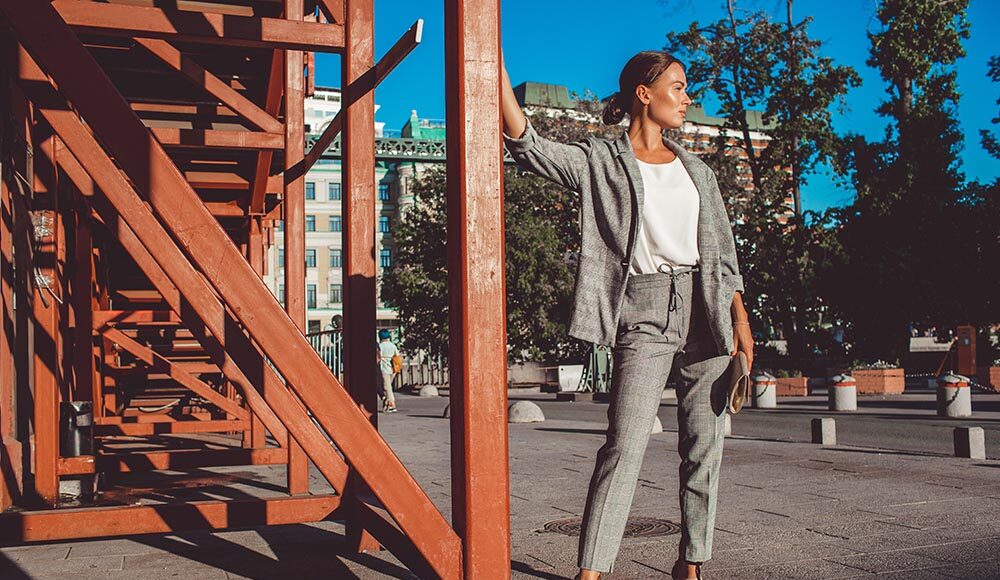
The best layered outfit of last September was not on a runway.
It was on a woman crossing Via Montenapoleone in a boxy leather jacket, a ribbed knit that swallowed her wrists, and a collar sharp enough to cut paper. She had assembled it in a hotel room in about nine minutes.
That gap between the show and the sidewalk is where street style lives, and it is also where most people get stuck. Runway layering gets built for a controlled room and a model who walks sixty feet. Your version has to survive a subway platform and whatever the weather decides at four o’clock. The techniques carry over anyway, provided you understand what the stylists are really doing.
What follows is not a trend report. It is the working logic behind the layered looks you keep screenshotting, broken into pieces you can use on an ordinary Tuesday. None of it requires a new wardrobe.
The Fashion Capitals Each Solve the Same Problem Differently
Watch the four cities back to back and the differences stop being subtle. Paris layers thin. A tissue weight turtleneck sits under a shirt under an unstructured blazer, and the whole assembly moves as one piece. The calendar coordinated by the Fédération de la Haute Couture et de la Mode is dense with houses that treat drape as the entire argument, and the sidewalk outside those shows reflects it within hours.
Milan runs the opposite play. Italian layering trades on weight and finish, with substantial wool coats thrown over knitwear that has real density to it, and the show calendar published by Camera Nazionale della Moda Italiana reads like a roster of houses built on tailoring and material. New York splits the difference and adds utility, because anyone attending shows there walks between venues in a city that punishes optimism about weather, and the designers gathered under the CFDA produce outerwear that works hard. London stays the loosest of the four.
The takeaway is not to pick a city and imitate it. It is to notice that every convincing layered look commits to a single idea about weight and then repeats that idea in every piece.
Texture Carries the Outfit When Color Will Not
Three black pieces in three distinct textures make an outfit. Three black pieces in the same texture make a uniform, and not an interesting one. This is the single most reliable trick in street style, and it costs nothing, since almost everyone already owns leather, ribbed cotton and brushed wool.
The organic part of organic layering comes from how those surfaces respond to light. Leather throws a hard shine. Chunky knit absorbs almost everything and reads matte. A sharp collar catches a line of light along its edge and holds it. Stack them and the eye keeps moving, which is exactly what makes a photograph worth taking. Flatten them into one finish and the eye slides off.
Start with two contrasting textures and add a third only if the first two feel too quiet. Four is usually one too many.
One Soft Element Keeps the Whole Stack From Turning Severe
Heavy layering has a failure mode, and it is armor. Leather over chunky wool over a stiff collar can read closed off, defensive, a little humorless. Stylists fix this the same way every season, by introducing one element that reflects light softly near the face.
A pearl necklace for women does this better than almost anything else in the jewelry drawer, because its luster is diffuse rather than sharp, so it warms the skin instead of flashing at the camera. Worn short, over a crewneck and under an open collar, it sits precisely where a heavy outfit needs relief. Worn long, dropped down the front of a knit, it draws a vertical line through all that volume.
The rule of thumb is one soft note, not three, since a necklace and a cuff and hoops together turn the relief into noise.
Proportion Is the Rule Nobody Bothers to Announce
Every layered look that works has one volume and one line. A voluminous top wants a narrow bottom, a wide leg wants something closer through the shoulder, and the pieces in between need to end where they can be seen. Hem placement matters more than anyone expects, since a sweatshirt that stops mid hip under a cropped jacket reads deliberate, while the same sweatshirt disappearing entirely reads like an error.
Fashion Week Online’s breakdown of hoodies suitable for street style makes the same point from the casual end of the wardrobe, noting how a boxy zip up behaves differently against wide jeans than a thin sweatshirt does under a coat. The garment changes, the physics do not.
Test it in a mirror from six feet back rather than up close. At that distance you see the silhouette the way a stranger on the street sees it, and any layer that is doing nothing becomes obvious immediately.
Effortless is a misleading word for all of this, because nothing on a street style feed is accidental, but it is also not complicated. Commit to one idea about weight. Contrast your textures. Put one soft, light catching thing near your face. Keep the proportions honest and let every layer earn its place.
Build one outfit this way and you will stop assembling the next one from scratch, because the logic transfers. The leather jacket that worked over the ribbed knit will work over a poplin shirt in April, and the necklace that softened it in September will do the same job with a linen blazer.
The woman on Via Montenapoleone was not lucky. She had four pieces she trusted and a clear sense of how they behaved together, which is the only real difference between a runway look and a good morning.