
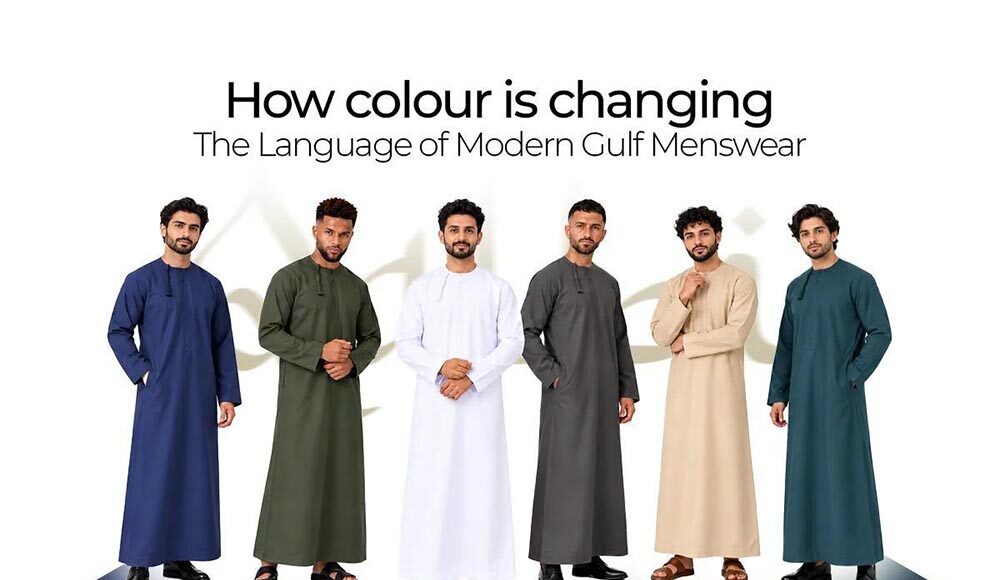
At an evening gathering, white thobes may still fill most of the room, pressed and bright, catching whatever light hangs overhead.
Against them, other colours register almost immediately. Navy near the doorway. A soft sand tone by the window. Grey somewhere in between. Deep green that reads close to black until its wearer moves under a stronger lamp and the colour finally shows itself.
What stands out is how unremarkable the mix can look. White remains the reference point of Gulf menswear, the colour most people picture when they think of a thobe, and nothing suggests it is losing that position. But the palette around it has widened, and men are using it to say something about the occasion, and about themselves, without touching the shape of the garment at all.
Colour Across a Long Line
Colour on a thobe does not behave the way it does on a suit. A tailored outfit breaks the body into pieces: lapel, shirt, tie, trousers, shoes. Each piece dilutes the next, so a strong colour in one area is tempered by everything around it. A thobe offers almost none of that interruption. The cloth runs from neck to ankle in one vertical line, with minimal layering and few seams that catch the eye.
So the colour becomes the garment. Grey on a thobe is the entire surface rather than an accent. Darker shades add visual weight, pulling the silhouette into a longer, more solid column, while paler tones let it read lighter and looser. The neckline turns into the place the eye keeps returning to, because it is one of the few points where anything changes. Alter the base colour and that small area of detail suddenly has a different job to do.
Omani Detail Gives Colour Somewhere to Work
Omani styling makes the point especially well. The Omani thobe is typically collarless, with embroidery worked around the neckline and down the short front opening, and a tassel hanging at the throat. On white, that decoration is quiet, often reading as texture as much as pattern and showing itself mostly when light rakes across the cloth.
Against navy or grey, the same kind of embroidery tends to move forward. Lines that could vanish into white become graphic, and the tassel, swinging slightly as the wearer walks, draws more of the attention. Sand softens the effect again, closer to how stitching looks on undyed linen. Forest green and teal produce a richer contrast altogether, enough to make a neckline look almost jewelled although the embroidery itself is unchanged.
Looking across a range of contemporary Omani thobes, it is noticeable how much the same refined stitching and long, modest cut can shift in character once the base cloth moves away from white. The detail stays constant. What surrounds it does the changing.
Navy Without the Ceremony
Of the darker shades, navy seems to sit most comfortably away from ceremony. It is far darker than white without approaching the severity of black, and that middle position gives it a useful calm. In evening light it settles rather than glows. Embroidery at the neck stays legible without taking over, which suits men who like detail but would rather it was noticed second.
It is also easy to wear. A navy thobe goes easily with brown leather sandals and a plain steel watch, and it reads as considered without tipping into formal. On a long silhouette it grounds the figure, so a generous length looks intentional rather than loose. The same wardrobe has room for navy at an evening dinner and white for a more traditional occasion.
Sand and Cream Change the Temperature
Late afternoon is where sand makes most sense. The light turns amber and a pale neutral cloth picks it up. Sand and cream sit close to white in brightness but lack its crispness, so the edges soften. Beside linen and pale stone, the colour almost dissolves into its surroundings, which is exactly what some men want from summer dressing.
It suits a wedding guest who would rather not compete with the occasion, and daytime heat more generally. There is a parallel with neutral tailoring in European menswear: a stone-coloured suit is still a suit, but it carries a different temperature from navy or charcoal. Sand does something similar for the thobe, warming it slightly and taking a little of the brightness out of white.
A Question of Taste
Forest green and teal are harder to justify in practical terms, and perhaps they do not need justifying. They are colours a man picks because he likes them. Forest green has a depth that changes noticeably between shade and sun. Teal sits between blue and green and refuses to settle into either, which gives it a slightly unexpected quality on a garment so often associated with restraint.
Neither alters the architecture of the thobe. The length, neckline, embroidery and tassel are exactly as they would be in white, so the colour ends up carrying most of the personality, and a man in teal is easy to pick out across a room.
White Has Not Gone Anywhere
None of this means white is being replaced. It remains central to Gulf dress and continues to be widely worn, in everyday life as much as in religious and more formal settings. Its brightness under strong sun, and the clean edge of freshly pressed white cloth, are qualities no other colour quite reproduces.
Alongside it, the wardrobe can simply stretch further. A man might keep several white thobes, one in navy for evenings and perhaps a sand for summer gatherings, reaching for each depending on where he is going and who he expects to see there.
A Familiar Garment, Read Differently
Fashion writing tends to describe change as replacement: a new shape arrives and the old one is retired. Traditional menswear rarely works that way. The garment stays recognisable, and change happens in smaller registers, through colour, finish, the proportion of a neckline or the context in which a piece is worn.
The thobe is a clear case. A wider spread of colours has given the same outline a much larger vocabulary, and some labels are building around that breadth. UK-based Qalbi Thobes is one example, working with UAE-made Omani and Emirati styles. Its current Omani range moves from white and sand into navy, grey, forest green and teal, which shows how much colour can alter the reading of otherwise familiar details.
It reflects something visible across much of contemporary menswear, where designers and wearers keep finding room to move inside forms they have no wish to abandon. A navy thobe at an evening gathering is a small decision. Repeated across enough rooms, small decisions are how a garment’s language changes.