
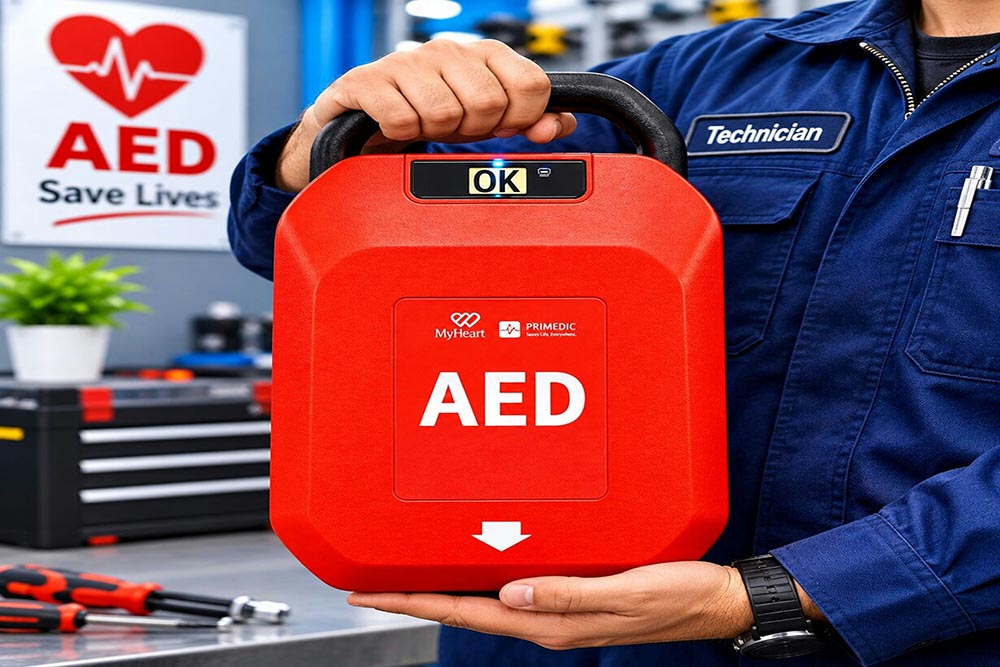
Automated external defibrillator AED are lightweight and easy to use.
They are designed to provide a shock to someone who has suffered sudden cardiac arrest. The shock stops the dangerous heart rhythm and gives the heart a chance to restart. As there is no medical knowledge required you can easily use them. Automated means they can analyse the heart rhythm. Once switched on, the device will give you verbal instructions and will only administer a shock if needed.
This article explains what an AED is, how they work and why it is imperative to use them as quickly as possible in Malaysia. We will also discuss what to look for when choosing, placing and maintaining an AED for your workplace, school, condominium or community.
What is an automated external defibrillator?
Automated External Defibrillators are lightweight medical devices that use batteries to detect the electrical activity of the heart. Two sticky pads will be placed onto the bare chest of the casualty. External refers to the pads being placed externally. Automated refers to the machine analysing the heart rhythm. There is no interpretation required from you as the machine will decide if a shock is needed.
It is important to understand what an AED actually treats! Sudden cardiac arrest is not the same as a heart attack. A heart attack occurs when there is a blockage to the blood flow to a section of the heart. The casualty will typically be conscious and in pain. Cardiac Arrest occurs when the electrical system of the heart fails to work which means the heart isn’t pumping properly. The casualty will collapse and become unresponsive. They will have stopped breathing or be gasping for breath. Without treatment they could die within minutes. An AED is specifically for this scenario.
How does an AED work?
Whilst all models will be slightly different they all follow the same process. The AED will give you verbal instructions.
- Call for help: Dial 999 (or 112 on a mobile phone). Send someone to get the AED and begin CPR if they are unresponsive and not breathing normally.
- Turn on AED: Follow the verbal instructions. Some AEDs will turn on automatically when you open the lid.
- Attach the pads: Place pads onto the bare, dry chest of the casualty. Ensure they are placed exactly how shown on the picture.
- Allow Analysis: Allow the AED to analyse the heart rhythm. Ensure no-one is near the casualty.
- Deliver the shock. If instructed to do so, deliver a shock. On a semi automatic AED you will be instructed to push the shock button. On a fully automatic AED it will deliver the shock after a warning. Ensure no-one is touching the casualty.
- CPR Resuming: Resumes CPR as prompted. Follow all the instructions until the ambulance crew takes over.
If instructed there is no shock advised do not think the casualty is okay. Continue CPR until help arrives or they begin to move or breathe normally.
Why it is important to use as quickly as possible (especially in Malaysia)
According to the American Heart Association (AHA), the chances of survival decrease by approximately 7-10% for every minute that passes without CPR and defibrillation. A study in 2024 found that for every minute that passes before the first shock is given, the chances of survival decrease by approximately 6%. Whilst the estimates of each study vary, they all show that the quicker you can deliver a shock the better. The AHA aims to have an effective AED program in place to deliver a shock within 3-5 minutes of collapse.
In Malaysia, data has shown how difficult this can be. A study published in the Medical Journal of Malaysia (March 2025) looked at ambulance service records from Sarawak, Penang and the Klang Valley between 2010-2019. Of the patients attended by emergency medical services, only 4.76% survived to be admitted to hospital. The median time between calling 999 and ambulance arrival was 17 minutes. Only 38% of cases had bystander CPR whilst only 1.5-2.6% had an AED used by bystanders.
In practice, the first few minutes will depend on what happens on the scene.
Where an AED will make the biggest difference
Cardiac Arrest can happen to anyone at any age and often without warning. An AED will be most useful in places where people work, gather or exercise and where an ambulance may take some time to arrive.
- Offices, Business Parks & Corporate campuses.
- Factories, Warehouses, Construction Sites & Industrial workplaces.
- Schools, Colleges & Childcare Centres.
- Shopping Malls, Hotels, Airports & Transport Hubs.
- Condominiums, Gated Communities & Townships.
- Gyms, Sports Halls & Clubs.
- Places of Worship & Community Halls.
As an employer you have a legal duty to ensure the safety, health and welfare of your employees whilst at work (Section 15 – Occupational Safety and Health Act 1994). Having an AED and trained first aiders in place is a practical way to prepare for the most time sensitive medical emergency that can occur in the workplace.
How to choose the right AED for your premises
Different manufacturers will list their specifications differently. It is best to compare like for like. The most important things to look for are:
Registration and supplier: Medical Devices in Malaysia are regulated by the Medical Device Authority (MDA) under the Medical Device Act 2012. All medical devices must be registered. Ask for registration details and ensure you are buying from a local supplier who can support you.
Guidelines: Look for an AED that follows current international guidelines for resuscitation such as those from the AHA and European Resuscitation Council. Ask how the manufacturer will update the device.
Easy to use: Look for a device with clear verbal prompts, visual prompts and clearly illustrated pads. Some AEDs will only have one language whilst others will have multiple languages already installed. This can be useful if your employees speak many languages such as Bahasa Malaysia, English, Chinese & Tamil.
CPR support: Some AEDs have a metronome or real time feedback to keep the rescuer at a steady pace.
Child friendly: If there may be children present, check if the model is child friendly with paediatric pads or child mode.
Water & Dust proof: The IP rating will tell you how water and dust proof the AED is. If the AED will be on a factory floor, outdoors or in a humid loading bay then you will want something with a higher IP rating than if it is in an air conditioned office. Check the operating temperatures.
Battery & Pad life: Pads and batteries have an expiry date. Ask how long they last, how to replace them and what the running costs will be.
Warranty & Support: Different brands will have different warranty periods. Some suppliers will offer extended warranty beyond the manufacturer (T&Cs apply). Ask about servicing, spares and repairs.
If you prefer to compare AED models side by side, CERT Academy has an AED page that compares 15 models. This includes models from MyHeart Primedic, HeartSine, Vivest, Defibtech, ZOLL, Philips & LIFEPAK. This compares CPR support, warranty, IP rating, battery & pad life and child friendly.
Where to place and maintain your AED
You want your AED to be easily accessible.
Keep it visible: Place your AED somewhere that people will pass by frequently such as near the reception, lifts, canteen, entrance or main production area. Ensure it is clearly labelled. Don’t place it in locked rooms or cupboards.
Time: The AHA suggests that an AED should be easily accessible so that the rescuer can retrieve it and get back to the casualty within 3-5mins. This means it shouldn’t take longer than approx 1.5-2.5mins to get there. Larger premises, multi-storey buildings and separate blocks may require more than one unit.
Keep it safe: Ensure the AED is stored within the manufacturers operating temperatures and not in direct sunlight. Consider placing it in a cabinet if it is in a public or outdoor area.
Ownership: Assign someone to be responsible for checking the AED. Have a backup person.
Regular checks: Most modern AEDs will perform self tests and have a status light. However, you will need to regularly check it (Follow manufacturers guidelines. Many organisations opt for monthly checks). Take note of the expiry dates of the pads and battery. Keep spare pads on hand. Log all checks.
Replace pads after use: Check battery. Follow manufacturers guidelines for servicing.
An AED works best with a trained team
An AED is one step in the process. Firstly you need to recognise the emergency, call 999/112, begin CPR, use the AED and pass to paramedics and hospital. Whilst AEDs are very easy to use and only require minimal training from the rescuer, practicing will make you quicker and more confident. This will give you the confidence to step in if a colleague collapses.
A sensible plan would be to have trained first aiders on every shift, CPR & AED training for employees, regular refreshers and have a notice on each AED outlining what to do in an emergency and where the nearest AED is. Carry out a short practise once or twice a year to ensure everyone knows where it is.
FAQs
Will using an AED harm someone who doesn’t need a shock?
No. The AED will analyse the heart rhythm and will only allow a shock to be delivered if it detects a rhythm that can be corrected with a shock.
Do I need training to use an AED?
Anyone can use an AED in an emergency. The AED will give you step-by-step verbal instructions. However, having training will make you quicker and more confident. It is a good idea to have training for any workplace that has an AED.
Can an AED be used on children?
Many models can be used on children using paediatric pads or child mode. Check the specifications of the AED you are purchasing. Always follow the prompts on the device.
How often should I service my AED?
Follow the manufacturer’s servicing schedule. At a minimum regularly check the status light, replace pads and batteries before they expire and log all checks. Your supplier can advise you on what servicing schedule to follow for your model.
Is an AED instead of calling an ambulance?
No. Always call 999 (or 112 on a mobile phone). An AED will bridge the gap until paramedics arrive.
Final Thoughts
An AED is a small piece of equipment that can make the difference between a tragic event and giving someone a second chance. Choosing an AED that is easy to find, confident to use and trustable will make the most difference. Ensure you choose the right model for your premises, place it within minutes, keep it maintained and train those around it. This article is general information and should not replace first aid training or medical advice.
About CERT Academy
CERT Academy Sdn. Bhd. provide First Aid, CPR, AED and Occupational Safety & Health training in Malaysia. Since 2013 we have trained 400,000+ first aiders and emergency responders for 8,000+ companies across Malaysia. We are registered with HRD Corp, accredited with ECSI, AAOS and endorsed by ACEP. The AEDs we compare are provided by our sister company MediCERT Supplies Sdn Bhd.