
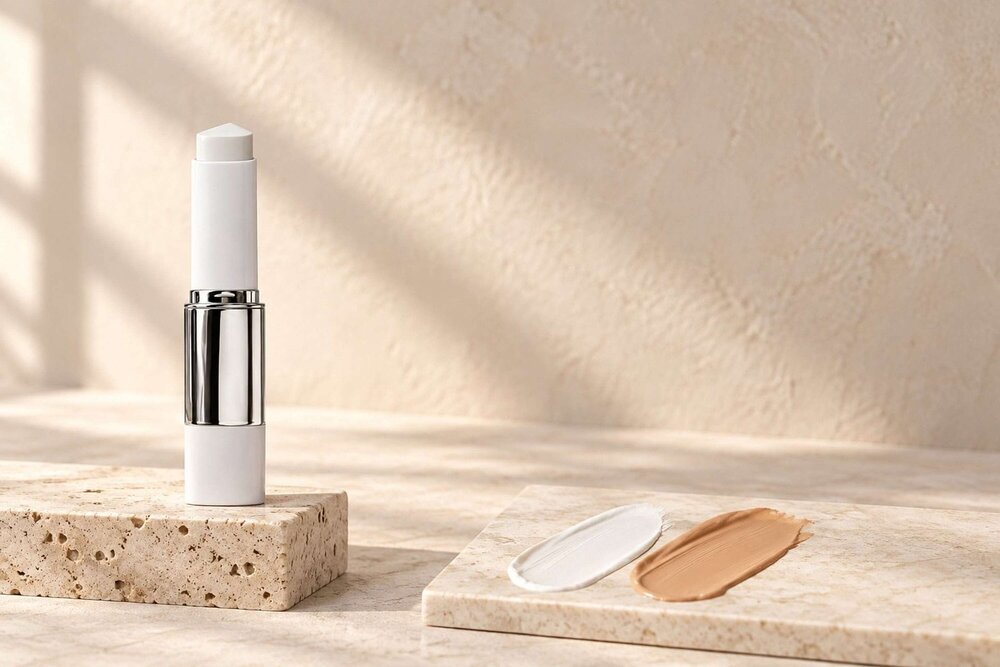
You do the turn with a stick. Its contents are white (or almost white) in color.
Then you create a colour stripe on your jaw line, begin to blend and after a few seconds the stripe becomes more like your skin. Online, it’s sold as a little magic and it is. The answer to the magic trick is more interesting, and more restricted, than the actual device itself.
The rainbow stick is not a make-believe item made from bedazzled paper, but a genuine device containing real chemistry. It’s not necessarily a shade neutral, nor is it a full coverage foundation, either, nor will it replace the knowledge of undertone. This guide aims to discuss the what is what and what is not out of the stick, as well as the circumstances under which you can expect to be disappointed.
What a color-changing foundation stick is
Teen colored foundation is a foundation that changes color upon application, due to the fact that there are tiny capsules in which the pigment is enclosed. The stick form is a solid version of that formula and it typically includes a built-in brush, or a barrel that is twist-up. When stored on the shelf it is light beige, pale, or white.
When it comes into contact with your skin or your fingers, brush or sponge, the capsules burst and send pigment into the skin. Color trick is only as important as the format. A stick can be used by hand and costs nothing to attach, and doesn’t need a pump, can be used in a train or car mirror in short strokes.
It was that convenience that made it come out on social media, perhaps even popularised under the Korean beauty brand. Nevertheless, colour change and stick format are two different functions equally with restrictions.
How the color change actually works
As usual, some explanation is offered as micro-encapsulation. Pigments embedded in a shell, which is usually made of silica, polymer or wax; the shell masks the color until applied to the skin.
The shells are broken open by rubbing into the skin using body heat and friction. The pigments are mixed with the rest of the mix and with the surface of your skin and the colour is shown. The sets of pigment are not unusual.
Kelly Dobos, cosmetic chemist, told Allure that the classes of pigments that produce the variety of skin tones are titanium dioxide to make things white, red iron oxide, yellow iron oxide, and black iron oxide. Mica or synthetic mica is also added in some formulas where it is in small particles to give shine and creates a soft optical smudge. The capsules are normally smaller than 100 micrometers across.
To give you perspective, the diameter of a human hair is about 20 – 200 micrometers. That’s where it ends the trick. No sensor, no facial pH scanner and no A.I. reading your face. It’s a mechanical and chemical change, which are initiated by application.
There are some that talk about the pH response and some that include dyes that change color in response to pH; most color-changing foundations change color because of encapsulated pigment (and above all friction) as described by the Allure piece. This is because the shade you obtain after rubbing the grass depends on the mechanism as well. Less pigment will be released on a light ‘switch’ rather than a firm ‘blend’.
A second layer on top is more. The product fits into a range, it doesn’t fit all skin tones. So, according to Perry Romanowski, CEO of Cosmidia electronics, which is also mentioned in the tale, it “is more of a marketing gimmick. He does not say the capsules don’t function, but rather the claim that one stick fits all.
Why K-beauty gets the credit
The concept comes from a much longer time ago than the TikTok videos suggest. Hestia is the brand whose product, a color-changing stick, represents the first commercial changeable foundation—a patent was filed by the brand in Japan in the 1990s.
It was Korean beauty companies that expanded it into a category and short-form video has done the rest. This white stick turned beige and sounds simple enough to record and take only three seconds to grasp. Practical implications for the Korean association.
This essentially indicates that it is essential to focus mostly on product pages, videos for affiliates and listings on amazon rather than on independent testing. It also implies that the category also entails claims that cosmetic chemists are not likely to defend as written including a face-fitting characteristic or an all day wear claim. You should consider country of origin when assessing a stick, rather than a quality assurance.
What the format does well
A color changing stick does not qualify to be in the bag because of its color shift. It is fast. On just an ordinary morning, one stroke and then 30 seconds of blending is all it takes to get a sheer even layer. No more shaking a bottle, and no more pump to fill, and no more pouring foundation on a hotel sink.
It doesn’t have a bad impact if you have it on your skin. It falls somewhere between Liquid Foundation (light, waterproof) and tinted Moisturizer, which means it’s a great option for weekends, travel, gift days at the gym and more, when a full base would be too much! Easy to re-apply.
The stick format provides the opportunity to touch up the centre of the face at lunchtime with no use of a damp sponge. Some versions of the same are equipped with a built-in brush that helps; a brush in the same cap collects lint and must be cleaned. Makes choosing shades easy. Knowing where you fall on the light-to-medium side and not planning to do a four shade test under store light means one stick should be close enough for casual wear.
Where the product stops working
The honest limits, those parts of the videos that aren’t covered. The range of shades is short. The majority of ‘color changing’ foundations are specific to light, medium, and tan skin undertones, and come in three to four family groups.
Darker skin tones often don’t receive as much attention as fairer skin tones, plus some products state that they can cause grayish or ashy undertones on darker skin. When purchasing dark coloured skin, test first and believe “universal”, not “universal”. It can be off-tone.
A formula designed around an undertone can look orange, pink, and gray on you, or any of these options can apply to your skin: cool, warm, and neutral. Color changing products change color on a lightness scale more consistently than undertone. Blanket of sheer to light weight.
The stick will not cover up breakouts, dark spots or melasma. It’s okay to make a second layer but once you start building the product begins to take on the characteristics of a mask. Average wear time. The time brands usually claim is between 8 to 12 hours healthy skin/or less on oily skin/heat.
Typically, no long-term polymer system is present in the formula. It is not skincare. Some formulas include skin care products like glycerin or niacinamide, and the product’s description may claim to be “hydrating.” Not a substitute for moisturizers; it is not an ointment for broken or irritated skin – must be patch-tested. Unless the label specifies otherwise, it does not include sun protection. Do not assume SPF. Read the packaging, and if necessary, apply a different sunscreen.
How to apply it without wasting product
Most people don’t realize that the method of application will make a significant difference in the outcome.
- Once you have the basics of a skincare routine, have a solid base to build on. Gently use moisturizer or sunscreen, and wait a minute or two to allow the lotion to settle in before putting on sun cream. When you use skin care pills on your stick, it will pill as well.
- Twist up a small amount. For one cheek, approximately ½ centimeter will suffice. Always add more as necessary.
- Apply in strokes that are short. Make two or three lines on each of the cheeks with one line on the forehead and one line down the chin. Don’t have a blaze of intense color across the face.
- Mix with a brush/damp sponge. A dense brush or damp sponge provides more even application, fingers will do the job in a pinch. Blend for 20-30 seconds following, and in daylight.
- Just add just as much. Apply a second thin layer of growth medium, but avoid using an overly thick layer all across.
Set selectively. You can apply powder to the T-zone to aid in wear time. Don’t paint for texture under and around the eyes or on the face.
How to choose a color-changing stick
There are 3 checkpoints on the way back that will spare you a trip back!
Don’t put swatch on the hand, put it on the jaw! The inside of your wrist is paler than your face. Using a marker, make a line along the jaw; blend the line; observe the line in diffused light. If you are in between shades repeat on the other side.
Explain what the product will do when most saturated and most unsaturated. A desirable listing will mention the shade range it’s intended for. The slight hint that a single shade is suitable for all skin types is a red flag, not a green flag.
Review return policy and ingredient list. Stick formulas may contain common fragrance, drying alcohols and essential oils as an irritant. You should do a patch test for a few days before applying to your entire face if your skin is sensitive.
A Budget-Friendly Stick to Try the Format
For those who would like to know what they are buying, a low-cost Color Changing Foundation Stick is a good choice for a first-test. Most of these have 3 colors (usually Natural, Light and Medium), are priced at about $20 to $25, and have a built-in brush so you don’t need to purchase a separate tool.
Check for a 30-day return/exchange window — it’s even riskier when you try it first. Product pages frequently tout the finish as “light, breathable and non-cakey,” and some claim it helps to decrease the oxidation of oranges. These are not test results, but rather claims made by the brand.
A great deal of listings will miss out the total ingredient list, or the net weight, so if this is essential to you, then don’t rely on the item being listed. This is a stick that will allow for an easy entry into the format. It includes three shades of light to medium, the included brush saves you an extra purchase and the price is typically below prestige sticks on the same range. For those who already have dark hair, or have cooler tones, this may not be the product for you to begin with.
FAQ
- Does changing colors make a good foundation?
Yes, it’s because the capsules burst open to release pigment. No, in the sense of saying that each stick is used for each face. It has a range of adaptability and is dependent on the manner of blending. - Is it safe or not to use a colour changing foundation?
The capsules are composed of silicon dioxide, a polymer, or wax and the pigments are generally cosmetic chemicals. Check their reactions with any cosmetic – particularly sensitive skin, do a patch test first. It would be inaccurate to say that any cosmetics are completely chemical free; the goal and the questions to consider are what ingredients are in the formula and how your skin responds to those ingredients. - Is it possible to change the colour foundation to old skin?
Yes, with adjustments. Sheer coverage and hydrating base can make for a good application, but over-laying can cause the stick to become sat in lines. The result isn’t as important as the prep and a damp sponge. - If the foundation changes its colour, does it offer sufficient sun protection?
No. If it is not written on the product label, or if it is and you have decided not to apply enough then you should use an additional sunscreen.
Conclusion
A “color changing” foundation stick is not a “colour machine” but a smart product to deliver a sheer foundation. It is ideal for when you are in need of speed and portability or for natural-looking finishes, and it is not ideal for deep or rich warm skin tones or for full cover. Purchase it if it’s easy and the format. Use a color swatch to judge color.