
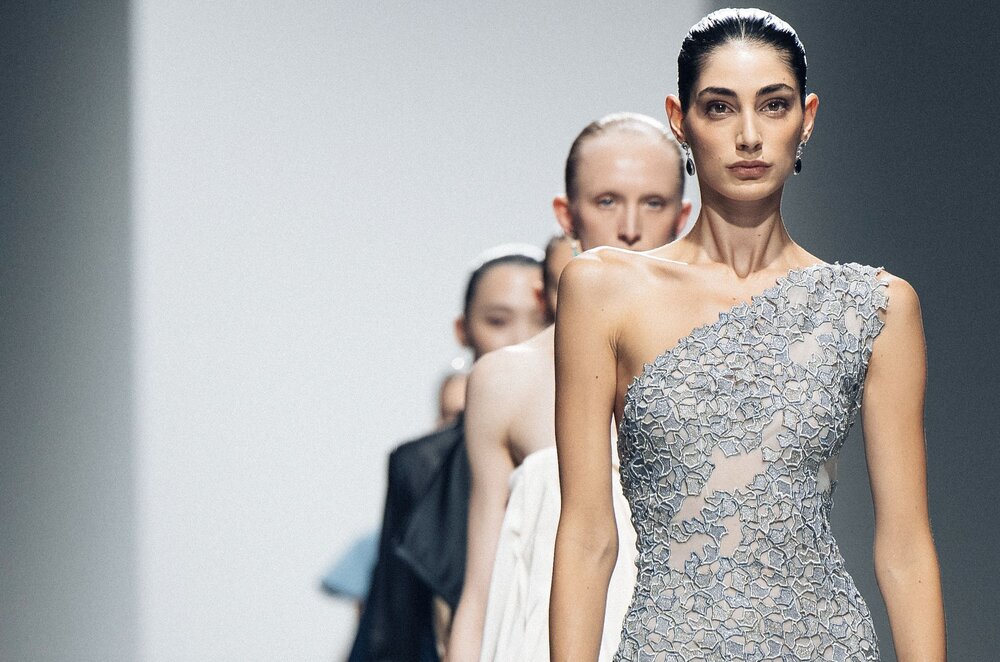
New York-based designer Rubin Singer returned to Paris Fashion Week to present his Spring/Summer 2027 ready-to-wear collection, HOMOMORPHISM, at the Palais de Tokyo.
The runway show brought together fashion, jewelry and music in a presentation that marked Singer’s return to Paris. The collection explored transformation, personal memories and the creative elements that have shaped the designer’s work throughout his career.
The name HOMOMORPHISM comes from mathematics and refers to a transformation in which the underlying structure remains unchanged. For Singer, this became a way to revisit familiar techniques, materials and ideas while giving them a new expression.
The collection was also deeply personal. Singer looked back at his childhood, his early experiences with ballet and his fascination with movement, proportion and dressing. These memories became part of the inspiration behind the new collection.
On the runway, the designer presented his signature architectural construction, asymmetrical draping and sculptural shapes, reinterpreted with a more controlled and tailored approach.
Denim, leather and translucent fabrics played an important role throughout the collection. Sheer materials were layered to reveal and conceal different elements of the garments, while a palette of black, ivory, white and navy was occasionally interrupted by unexpected touches of color.
Rather than looking back with nostalgia, HOMOMORPHISM was about taking familiar elements and transforming them into something new.
As Singer described the idea behind the collection: “The variables have changed. The structure remains.”
Jewelry Meets Fashion: Jill Reno Collection
An important part of the runway presentation was the collaboration with American jewelry designer Jill Reno, founder of Jill Reno Collection.
A second-generation artist with 26 years of experience in jewelry design, Reno joined Rubin Singer for his Spring/Summer 2027 Paris runway show, bringing her sculptural jewelry creations to the presentation.
Her designs are known for geometric shapes, strong forms and dramatic monochromatic combinations. For the runway, the jewelry complemented Singer’s architectural approach to fashion, creating a connection between the construction of the garments and the sculptural character of the accessories.
The collection featured an extensive range of precious metals, including white, rose, yellow, green and black gold, alongside rare natural, earth-mined gemstones selected for their distinctive colors.
The collaboration brought two creative disciplines together, showing how jewelry can become part of the overall runway image rather than simply an accessory.
The Team Behind the Show
While the audience sees the final runway presentation, every fashion show is the result of extensive preparation and the work of many professionals behind the scenes.
More than 200 people were involved in the project, including models, volunteers, makeup and hair specialists, casting professionals, producers, showrunners and technical teams.
Casting Director Mariia Anosova was responsible for selecting the models and coordinating the casting process, working closely with the production team to prepare the runway lineup.
The makeup direction was handled by The Backstage Team, led by Fabiana Graziani, together with independent makeup artists Priynka Sharma, Michéle Magdić and Faih Kotza.
The beauty team worked on creating and executing the makeup looks for the runway. Beauty brands La Bonne Brosse, CAIA Cosmetics, TRUSS Professional, Onerique Paris and OPI France also participated in the project.
The hair direction was led by international Hair Director Juan Lino, working alongside independent hair specialist Zenzi Sebastini. Together, they were responsible for developing and executing the hairstyling concepts for the runway presentation.
Producers Valentina Varnavskaia, Ruslan Evseev and Cesar Topaloff coordinated the organizational, technical and creative production processes, bringing together the designer, backstage teams and technical departments.
The showrunner managed the timing and sequence of the runway presentation, ensuring that the different departments worked together throughout the show.
An important role was also played by the volunteer team led by Yulia Krasik, who supported backstage operations, model movements, communication between departments and the daily coordination of the venue.
The project was also supported by Ulike, while the original music and audio concept for the runway show were created by Vilde Tuv, adding another creative element to the presentation.
A Return to Paris
For Rubin Singer, the September 29 presentation was more than the launch of a new collection. It marked his return to the Paris runway and an opportunity to introduce a new chapter of his work to an international audience.
Coming from a multigenerational family tradition of European couture and garment making, Singer has developed a distinctive design language over the years, combining technical construction with movement, proportion and dramatic expression.
His designs have been worn by internationally recognized performers and public figures and have appeared on red carpets and major stages around the world.
With HOMOMORPHISM, Singer returned to the foundations of his creative identity while continuing to develop them in a new direction.
The presentation at Palais de Tokyo brought together the work of the designer, jewelry artist, beauty professionals, musicians and production teams, demonstrating how many different creative and technical disciplines contribute to a single runway show.
As Paris Fashion Week continued with presentations from designers around the world, Rubin Singer’s return added another international name to the season’s fashion calendar.