

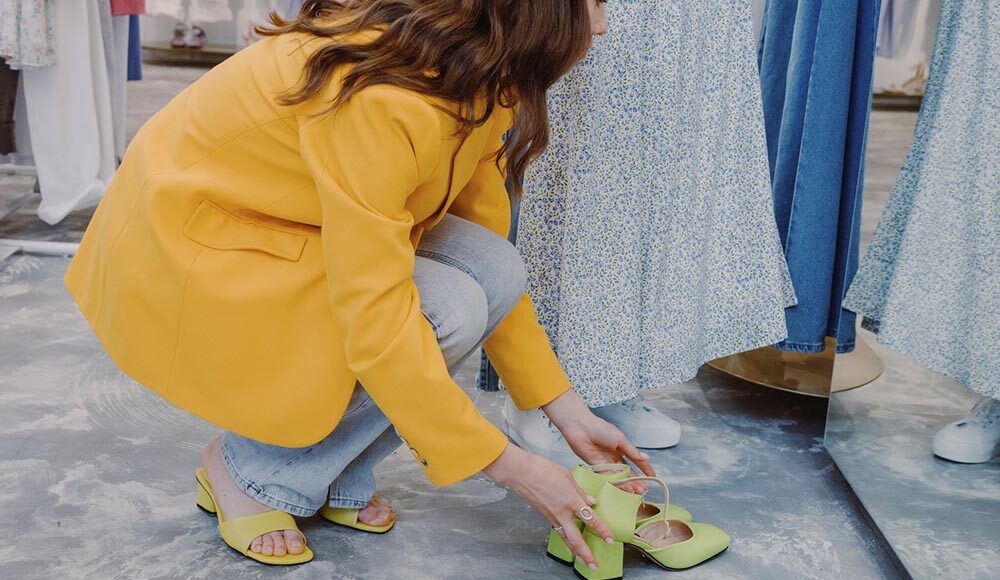
You think you know your shoe size.
You’ve worn it for years. Then a new pair pinches, your heel slips, or your toes go numb on a long day, and you wonder what went wrong. Here’s the uncomfortable truth: most people are wearing the wrong size and have no idea.
Feet change through adulthood. They spread, arches drop, and the number stamped inside your last pair was probably a guess to begin with. Finding the right shoe fit is less about memorizing a number and more about knowing your actual feet. Let’s fix that.
Stop trusting your “usual size”
Shoe sizing is not standardized. A 42 in one brand runs like a 41 in another, and a US 9 sneaker feels nothing like a US 9 dress shoe. The last (the foot-shaped mold a shoe is built around) differs from maker to maker, which is why your go-to number betrays you the moment you switch brands.
So the first rule: measure, don’t assume, especially online, where you can’t slip them on first.
It’s not just length: width and the toe box
Length gets all the attention. Width and toe room are where most fits actually fail.
Your toes need to spread when you walk and land. A pointed or narrow toe box crushes them together, which over the years can push the big toe inward and set up bunions, corns, and that constant low-grade ache you’ve started ignoring. A shoe can be the right length and still be wrong if your toes have nowhere to go.
This is exactly where minimalist and barefoot footwear take a different approach. They’re built around the natural shape of the foot, with a wide toe box that lets your toes splay instead of bunching. The catch is that they’re sized differently, so your conventional number won’t carry over. If you’re trying a pair, measure your foot and find the right barefoot shoe size by adding a little toe room to your length rather than guessing. The fit logic is the same as any good shoe, just more honest about what your foot is doing in there.
How to measure your feet at home
You need paper, a wall, a pen, and a ruler. Five minutes, tops.
Stand on the paper with your heel against the wall. Mark the tip of your longest toe. (Worth noting: your longest toe isn’t always the big toe. Plenty of people have a longer second toe, and that’s the one that hits the front of the shoe.) Measure from the wall to the mark. That’s your foot length.
Do both feet. Almost nobody is symmetrical, and one foot is usually larger. Fit the bigger one. Squeezing the larger foot into a smaller shoe to match the other is how blisters are born.
Measure at the end of the day, too. Feet swell as you walk, and a shoe that fits at 9 a.m. can feel like a vice by evening.
The five-point fit check
Got the shoes on? Run through this before you commit:
- Thumb’s width at the front. About a finger’s width between your longest toe and the end. Less than that, and you’ll bruise nails on the descent of every staircase.
- The heel holds. A little slip on a brand-new shoe is normal and usually eases. Sloppy, sliding heels are not.
- It flexes where your foot flexes. The shoe should bend at the ball of your foot, where your foot bends. If it folds in the arch, it’s too long.
- Width feels snug, not tight. The widest part of your foot should sit in the widest part of the shoe, with nothing bulging over the edges.
- Walk before you decide. Don’t judge a shoe standing still. Take a lap. Pressure points announce themselves within twenty steps.
Common mistakes that wreck the fit
Sizing down because the half size isn’t in stock. Buying shoes to “break in” when they hurt out of the box (good shoes are comfortable on day one; leather softens, but it won’t rescue a wrong size). Shopping by the number on the box instead of the feel on your foot. And the classic: choosing looks over fit, then limping through the night.
A word for the style-first crowd
Fashion and fit are not enemies, but when they fight, fit wins. A gorgeous shoe you can’t walk in is a prop, not footwear. The trick is finding styles cut for your foot shape rather than forcing your foot into a silhouette. Designers are increasingly building looks that respect anatomy, and your feet will outlast any trend, so treat them accordingly.
FAQ
How much room should there be at the end of a shoe?
About a thumb’s width, roughly 1 to 1.5 cm, between your longest toe and the front. Enough for your foot to slide forward as you walk without your toes hitting the wall.
Should I buy shoes a size bigger to be safe?
No. Oversized shoes let your foot slide around, which causes blisters and instability. You want room in the toe box and a secure heel, not a bigger shoe overall.
What time of day is best to try on shoes?
Late afternoon or evening, when your feet have swelled to their largest. Shoes fitted to morning feet often turn tight later.
Why do my feet feel like different sizes in different brands?
Because sizing isn’t universal, every brand builds on its own last, so the same labeled size varies in length, width, and shape. Always measure and check the brand’s own chart.
Can the right fit really prevent foot pain?
Often, yes. A lot of everyday foot pain traces back to shoes that are too short, too narrow, or too pointed. Correct length, real width, and toe room solve more problems than people expect.
The bottom line
Stop shopping by a number you memorized a decade ago. Measure both feet, fit the larger one, leave your toes room to move, and walk before you buy. Do that, and the right pair stops being a lucky accident and starts being something you can repeat, every single time.